


Introduction
Materials and Methods
Results
Yearly publication count
Bibliometric analysis of search results
Effect of moisture content on grain storage
Sensor methodology
Challenges and Opportunities
Conclusion
Introduction
Grain, also often called cereal, is an important staple food in almost every culture worldwide. Grain is an excellent source of carbohydrates and proteins, providing calories and energy for humans (Serna Saldivar, 2016; Wrigley and Taylor, 2023). Various needs can also be obtained from grain, such as making animal feed, cooking oil, fuels, cosmetics, bioethanol, and alcohols (Batey, 2017; Mabasso et al., 2024). So, it is important to maintain grain quality from harvesting through distribution, drying, and storage, ensuring it remains until it is consumed or processed into derivative products (Aswani et al., 2024; Alencar and Faroni, 2011).
Many grain varieties have hydrophilic properties that are very susceptible to environmental humidity and temperature (Flor et al., 2022). Humidity and temperature significantly affect quality, triggering the emergence of pests, fungi, and insects (Yigit et al., 2018; David et al., 2024). So that grain needs to be dried as soon as possible after harvest to survive and be stored for a long time. The drying process is carried out on grain to achieve a specific moisture content, preventing spoilage while preserving quality and nutritional content (Jimoh et al., 2023).
Moisture content (MC) is one of the most important parameters to be observed during the storage process, where the higher the MC, the more it triggers the growth of mold, but if it is too low, it causes the grain to be brittle and easily broken (Ramli et al., 2024; Kibar, 2015). Grain with high moisture content will increase microbiological activity, accelerating deterioration and mold growth (Zhao et al., 2020), one of which is characterized by increased CO2 production (Mabasso et al., 2024). The MC value for good storage of each type of grain can vary and depends on environmental conditions. Some analysis shows that for rice and paddy, the MC value should be kept between 12-14% for storage (Ramli et al., 2024). For wheat seeds, it should be stored at MC below 16% as higher MC will cause serious deterioration and increased mold growth (Wang et al., 2020).
In general, MC measurement methods for grain can be divided into two categories: direct and indirect. Direct measurement can be done by several methods, such as the gravimetric/oven method, the distillation method, and the coulometry/Karl Fisher method (Flor et al., 2022). The three direct measurement methods are also referred to as destructive tests because they damage the sample under measurement. Direct methods also require a long time, are costly, and are not practical for quick, online measurements. This method is suitable for comparison or calibration for indirect method measurements that use sensors and online (Yigit et al., 2018; Al-Rawi, 2024). Of the three methods, gravimetric/oven is the most widely used and most accurate (Azmi et al., 2021).
Indirect methods are widely used because they are more practical, provide faster results, and are easier to use. The indirect measurement method is suitable for online grain condition monitoring. Indirect methods measure electrical parameters. Some indirect measurement methods include electrical resistance/impedance, dielectric constant change, microwave, magnetic measurements, magnetic resonance, ultra-wideband (UWB) radar, ultrasonic/acoustic, infrared thermography (IR), infrared spectroscopy, hyperspectral imaging (HIS), and equilibrium relative humidity (ERH) (Flor et al., 2022). A lot of research and development has been done on these methods to improve the accuracy, speed, and robustness of the sensors under various conditions.
Currently, moisture content measurement technology is also developing further to optimize and combine the use of various indirect method technologies that use sensors with wireless connectivity, such as wireless sensor networks (WSN), radio frequency identification, machine learning and the use of neural networks to improve the prediction and estimation of grain moisture (Flor et al., 2022; Lima et al., 2024).
Given the importance of using technology to improve accuracy, speed, and connectivity in measuring moisture content in grain storage, this systematic review was conducted to identify the latest research on the development of moisture-sensing technologies, particularly in the grain storage process. This systematic review was conducted by references published between 2015 and 2024. The review provides an explanation of the development of moisture content sensing technology in its application to grain storage, thereby offering further development opportunities to address existing challenges.
Materials and Methods
This work adopted a two-step methodological approach, combining bibliometric analysis and systematic review. A bibliometric analysis was conducted to map the research landscape and identify key trends in moisture content sensing technologies. Scopus was used as the primary source for collecting data. Publications from 2015-2024 were gathered using the following Boolean terms: (grain OR grains) AND storage AND ("Moisture Content" OR "Moisture") AND (sensor OR sensors).
The search also filtered to only Article, Conference paper and Review paper in English. This initial search generated 97 papers, which were used as the dataset for bibliometric analysis. Furthermore, the co-occurrence of keywords was analyzed using VOSviewer to explore the knowledge components and structure of the research domain by identifying clusters of the most common keywords in the literature. Collaboration networks were also being identified using this software.
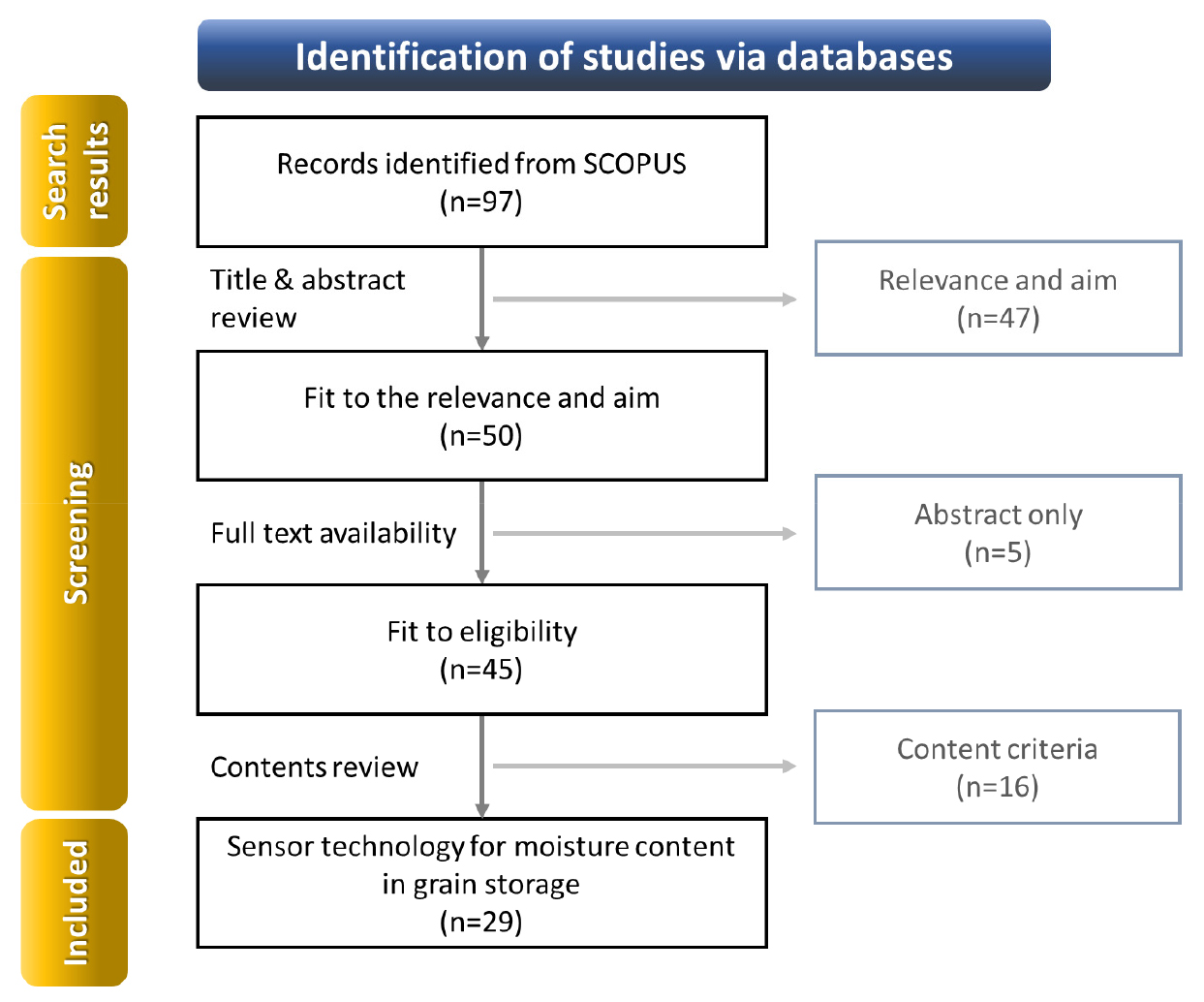
Following the bibliometric analysis, the systematic review methodology was conducted by following the Preferred Reporting Items and Meta Analysis for Systematic Reviews (PRISMA) guidelines to explore the development of moisture content sensing technologies in their application for grain storage. The articles were then subjected to a multistep screening process. Initially, their titles and abstracts were reviewed for relevance and aim, and those that were not related to moisture content sensing technologies for grain storage were excluded (47 papers). The second step was to screen for full-text availability (45 papers). The third step was a thorough examination of the articles, selecting only those that discuss measuring grain moisture content in storage using sensor technology. In the end, 29 articles were included in this systematic review (Fig. 1).
Results
Yearly publication count
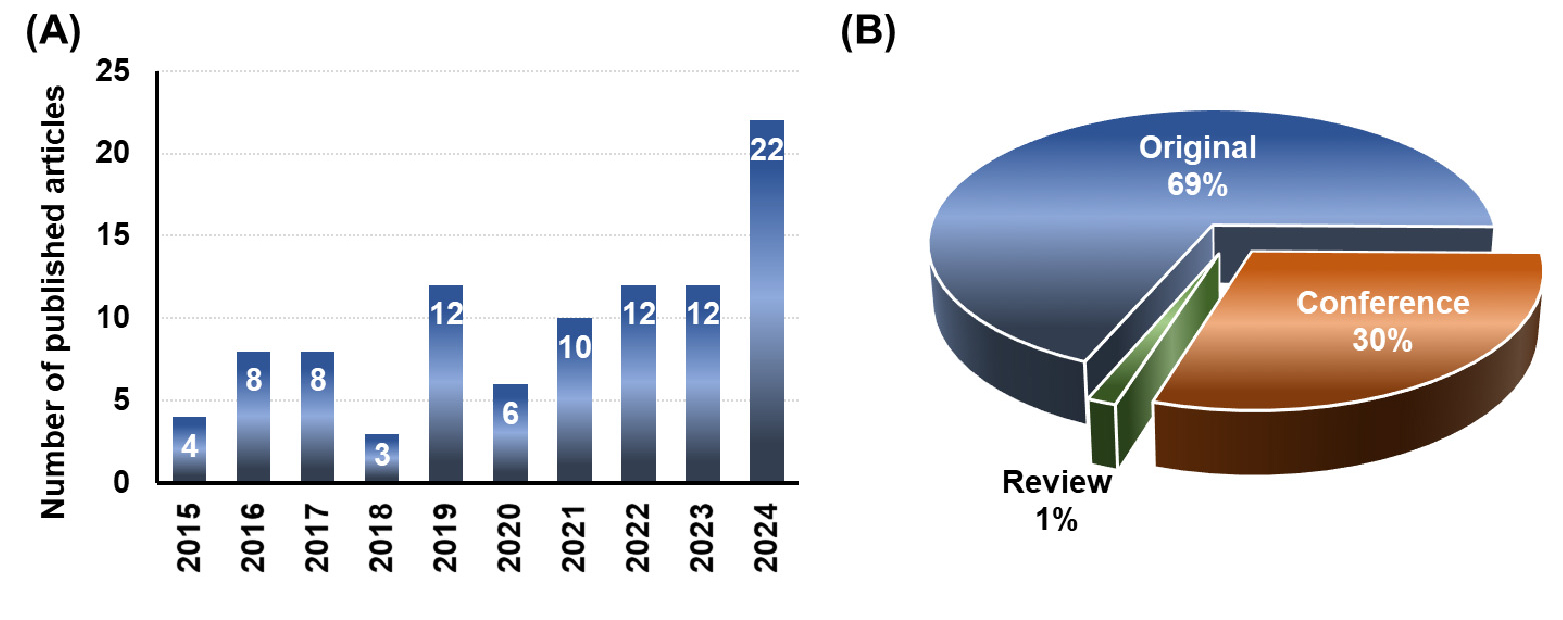
Overall, 97 articles on moisture sensing in grain storage were searched in the Scopus database. The number of published research articles seems to have increased from 2015 to 2024. However, the number of documents dropped significantly in 2018 and 2020, before rebounding in 2019 and 2021. The peak was in 2024, with 22 documents published, more than 5 times as many as in 2015 and almost twice as many as the year before (Fig. 2A). Most of the published types were original research articles, at 69%. 30% were conference articles, and one was a review article (Fig. 2B). Increasing publications highlight the importance of technological advances in moisture sensing for grain storage to ensure grain quality.
Bibliometric analysis of search results
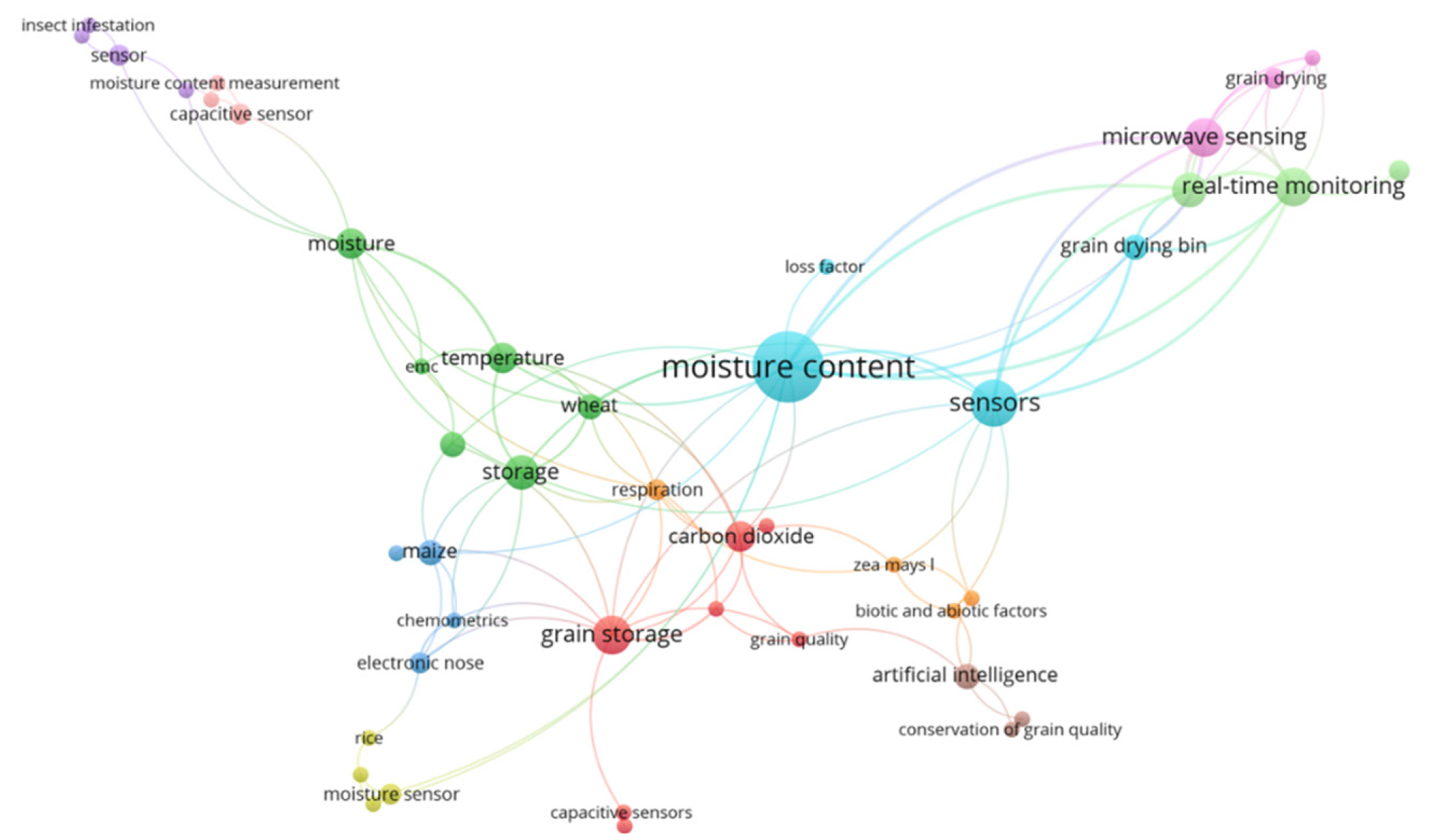
The most occurring keywords from the search results and their relationships were analyzed. The most frequently occurring keywords were sensors, storage, grain storage, real-time monitoring, microwave sensing, temperature, and artificial intelligence. The larger the circle, the more occurrences of these keywords, and the line shows the relationship between keywords. The smaller the circle or the position of the keyword in the corner, the more it suggests that few researchers have discussed it, indicating its potential and the need to develop it further. The network map shows moisture content or moisture related to loss factor, carbon dioxide, temperature, and respiration (Fig. 3).
Effect of moisture content on grain storage
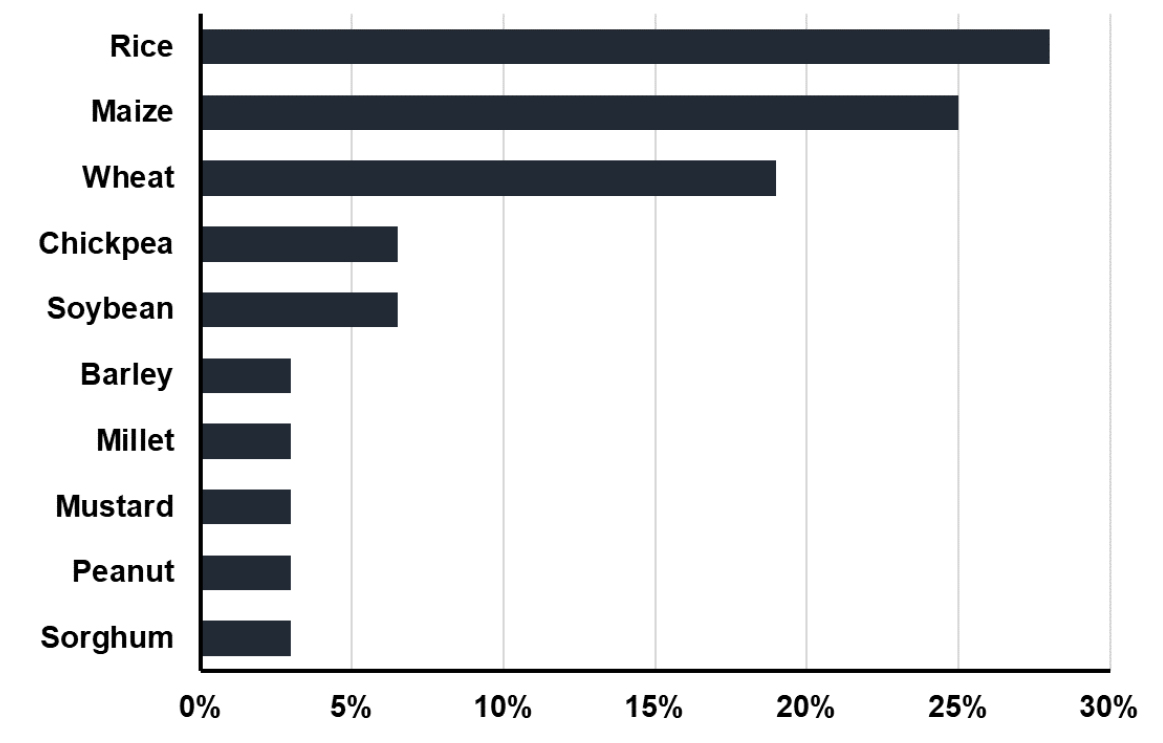
Ten types of grains were used in the research articles found for the systematic review. Among the ten types of grains, the three main types are rice, maize, and wheat. These are the most widely consumed staple foods in the world. Following the three main grains, soybeans and chickpeas were used more frequently than other grains, such as peanuts, sorghum, barley, mustard, and millet (Fig. 4).
One of the most important factors in maintaining grain quality during storage is moisture content. Grain storage involves reducing the moisture content of grain, as high water content can trigger metabolic activity in grain (Mabasso et al., 2024). The higher the metabolic activity, the faster spoilage occurs, mold develops, and insects are attracted to it (Maramba et al., 2019). Metabolic activity in grain is also indicated by an increase in CO2 levels, which is why some current studies use CO2 levels as a parameter to monitor moisture content in grain (Souza et al., 2024).
Table 1 shows the effect of moisture content on grain conditions in storage by grain type. As explained earlier, each grain has its own characteristics to consider when determining the appropriate moisture content so that the grain can be stored and its quality maintained for an extended period. Based on the studies included in this systematic review, not all studies discuss the impact of moisture content on grain conditions; instead, they focus only on the development, design, and performance of sensors.
Table 1.
Effect of moisture content (MC) on grain in the storage
| Grains | MC for storage (%) and its effect | MC leading deterioration (%) and its impact | Ref. | ||
| Maize | 12-14 |
Low metabolic activity Good quality up to 120 days of storage Low CO2 level | 16-18 |
High metabolic activity Increased CO2 production Acidity increased Initiation of germination over 30% | Mabasso et al., 2024; Rodrigues et al., 2024; Dean et al., 2019; Bilhalva et al., 2023; Coradi et al., 2022 |
| Soybean | ≤12 | Higher quality | >12 | Increased CO2 production | Lima et al., 2024; Ferreira J. et al., 2024 |
| Rice | 10-14 | Prolong quality | 20 | Causing severe mold and decay | Liu et al., 2024; Reddy et al., 2016 |
| Millet | 12 | Prolong quality | 20 | Causing severe mold and decay | Liu et al., 2024 |
| Wheat | 12-14 | Long-term storage | 20 | Causing severe mold and decay | Zhao et al., 2020; Liu et al., 2024; Singh and Fielke, 2017 |
In maize (corn), the optimal moisture content for long-term storage is 12-14%, characterized by low metabolic activity and low CO2 levels in storage (Dean et al., 2019; Bilhalva et al., 2023). Storing maize at 14% moisture content results in low CO2 levels and maintains quality for up to 120 days of storage (Mabasso et al., 2024). Additionally, temperature parameters play a role, indicating that a temperature of 17°C with a moisture content of 13% provides the best conditions (Coradi et al., 2022). Furthermore, relatively high moisture content (16-18%) can trigger damage to maize grains characterized by increased metabolic activity, elevated CO2 levels, and increased acidity, which are associated with grain damage caused by fungi or enzymes (Mabasso et al., 2024; Rodrigues et al., 2024; Dean et al., 2019; Coradi et al., 2022).
Soybeans indicate that the moisture content for good storage is 12%, which is characterized by maintained grain quality, whereas a moisture content above 12% increases CO2 levels (Lima et al., 2024; Ferreira J. et al., 2024). For rice, the moisture content for storage is between 10% and 14% to increase the storage period (Liu et al., 2024; Reddy et al., 2016). For millet, the optimal moisture content is 12%, and for wheat, it is between 12 and 14% to enable long-term storage. At a moisture content of 20%, mold and decay will occur extensively (Zhao et al., 2020; Liu et al., 2024; Singh and Fielke, 2017).
Sensor methodology
Current sensor development is entirely focused on indirect, mostly non-contact methods, meaning the sensor does not need to come into direct contact with the grain to measure moisture content and maintain grain quality. Connectivity and remote data collection are now very important for obtaining real-time data to improve measurement efficiency. In addition, some are developing a moisture content prediction algorithm using machine learning models to improve efficiency and reduce laboratory work. However, the accuracy of these systems still needs to be tested, developed, and researched to ensure reliable results. Typically, direct methods, such as oven drying, serve as calibration standards for comparing research- developed sensors to determine their accuracy. In practice, calibrating measuring instruments/sensors requires accurate standard methods, which often take a significant amount of time.
As shown in Table 2, the capacitive and Equilibrium Relative Humidity (ERH) methods are among the most commonly developed approaches for measuring moisture content (MC) in the studies reviewed. The capacitive method is favored for its simple structure, low cost, and ability to support continuous, rapid measurements. However, it also has notable limitations, such as low measurement accuracy and poor stability (Shao and Chu, 2021). Most capacitive sensors for moisture measurement are contact-type, which often encounter issues such as electrode contamination and signal drift. The performance of these sensors largely depends on the sensor design, including the electrode shape and the distribution of the electric field.
Table 2.
Sensing methods, operating principles and their characteristics of MC sensors
|
Moisture content measurement method | Grains | Operating principle | Characteristics | Ref. |
| Capacitive |
Chickpea, Mustard, Maize, Sorghum |
Measures moisture-induced changes in capacitance resulting from variations in the dielectric constant |
∙ A shielding electrode was introduced to enhance the penetration depth of the concentric fringing field (CFF) capacitive sensor ∙ The spiral-based capacitive sensor is simple, low-cost, and well-suited for moisture content monitoring ∙ Dielectric models were developed to improve prediction accuracy ∙ Finite element–based structural optimization increased penetration depth, capacitance, and sensitivity | Aswani et al., 2024; Dean et al., 2019; Aswani and Islam, 2023; Berbert et al., 2019; Wang et al., 2024 |
|
Multisensor Machine Learning Approach | Maize |
Estimates moisture content using machine learning models with inputs from multiple sensor modalities |
∙ Machine learning models, including ANN and RF, were effective for predicting moisture content (MC) ∙ ANN demonstrated strong potential for quality estimation while reducing qualitative losses and laboratory analysis costs | Lima et al., 2024; Lutz et al., 2022; Rodrigues et al., 2024; Coradi et al., 2022; Lutz and Coradi, 2023; Kaushik and Singhai, 2019 |
|
RF-based Moisture Content and Machine Learning |
Rice, Wheat, General Grain |
Determines moisture content from RF signals processed through machine learning algorithms | ∙ Stable and accurate sensing was achieved at distances up to 80 cm and over a wide range of rotation angles using a passive RFID tag | Azmi et al., 2021; Shen et al., 2022; Chen et al., 2021; Liu et al., 2022 |
|
Equilibrium Relative Humidity (ERH) |
Maize, Rice, Soybean |
Estimates moisture content based on equilibrium between ambient air humidity and material moisture |
∙ CO<sub>2</sub> monitoring is effective for the early detection of increasing moisture content ∙ Real-time connectivity can be implemented using Bluetooth and GSM mobile technologies | Mabasso et al., 2024; Maramba et al., 2019; Bilhalva et al., 2023; Ferreira J. et al., 2024; Reddy et al., 2016 |
| Dielectric |
Maize, Millet, Rice, Wheat |
Determines moisture content by detecting changes in the material’s dielectric permittivity | ∙ The humidity sensor design was improved by optimizing probe spacing and material selection | Liu et al., 2024 |
| Microwave |
Rice, Wheat |
Estimates moisture content by analyzing microwave signal attenuation or phase shift through the material | ∙ The wide-ring sensor configuration provided higher accuracy, whereas the coupled-line configuration offered greater sensitivity | Mun et al., 2015; Yadav and Chittora, 2023 |
| Ultrasonic |
General Grain |
Determines moisture content by measuring changes in ultrasonic wave velocity or attenuation within the material | ∙ The ultrasonic grain moisture detection device achieved improved accuracy within a short measurement time and was easy to operate and maintain | Shao and Chu, 2021 |
|
Radio Tomographic Imaging | Rice |
Detects moisture content using RF sensing followed by image reconstruction processing | ∙ A non-destructive RTI system enabled repeatable, real-time moisture mapping in rice silos | Ramli et al., 2024 |
|
Electrical Capacitance Tomography |
Barley, Rice |
Maps permittivity by measuring capacitance between electrodes | ∙ A non-destructive, imaging-based electrical capacitance tomography (ECT) method accurately detected grain moisture and was unaffected by bound or free water states | Yu et al., 2024 |
| Optical | Wheat |
Determines moisture content based on light absorption or reflection at specific wavelengths | ∙ A quasi-distributed layout of fiber-optic temperature and humidity sensors enabled monitoring across the grain depth | Zhao et al., 2020 |
|
Infrared Spectroscopy | Rice |
Detects moisture content through variations in reflected light intensity | ∙ A portable, low-cost, and high-precision real-time sensor for rice moisture detection was developed using the characteristic NIR absorption band at 1450 nm | Lin et al., 2019 |
To address some of these limitations, Aswani et al. (2024) developed a Concentric Fringing Field (CFF) capacitive sensor for non-contact moisture measurement. Adding a shielding electrode between the sensing and driving electrodes increased the sensor's penetration depth. This design improved sensitivity, electric field strength, and the sensor’s ability to minimize external interference. As a result, the sensor remains low-cost, simple, and durable while offering effective performance for non-contact moisture sensing.
The ERH method estimates moisture content indirectly, by calculating the equilibrium moisture content (EMC) of stored grains through the measurement of relative humidity (RH) and temperature of the intergranular air (Singh and Fielke, 2017). While ERH-based methods were once widely used and considered reliable, recent research has raised concerns about their accuracy and efficiency when used alone. While this method has been widely used, recent studies have found that relying solely on ERH to evaluate grain quality is no longer the most effective or efficient approach for predicting grain quality (Mabasso et al., 2024).
In addition to the widely adopted ERH and capacitive methods, several other moisture-sensing techniques demonstrate significant potential for grain monitoring applications. Dielectric and RF-based methods, which are conceptually similar to capacitive sensing, rely on changes in dielectric permittivity and often integrate machine learning or RFID technologies for enhanced accuracy and remote sensing capabilities. The use of RFID promised the sensor application stability, accuracy, sensing up to 80 cm distance, and wide rotation angles (Shen et al., 2022).
Microwave and ultrasonic techniques offer non-destructive measurement by analyzing signal attenuation or wave velocity, making them suitable for rapid, real-time moisture detection. More advanced imaging approaches, such as Radio Tomographic Imaging (RTI) and Electrical Capacitance Tomography (ECT), allow spatial moisture mapping inside bulk grain storage without damaging the material. However, these are still emerging in practice. Yu et al. (2024) developed a non-destructive, imaging-based method (ECT) that accurately detects grain moisture, regardless of whether water is bound or free. Although this sensor is sensitive to sample position, size, temperature, and density.
Optical and infrared spectroscopy methods utilize light reflectance or absorption to estimate moisture content, offering a portable, precise solution especially useful in quality control settings. A quasi-distributed fiber optic temperature and Humidity Sensor System based on Fiber Bragg Grating (FBG) has been developed (Zhao et al., 2020). This enables temperature and humidity monitoring throughout the grain's depth, even under dusty, variable conditions. Unskilled technicians can install it, which offers real-time data, enhances granary management, improves safety by avoiding electrical systems, and reduces spoilage and costs.
The factors of speed, simplicity, and accuracy have become key indicators of technologies that are increasingly favored by the public. This is also reflected in several recent studies, which attempt to measure and predict grain moisture in real time by implementing wireless communication technologies such as Bluetooth, GSM, Wi-Fi, ZigBee, and even Wireless Sensor Networks (WSNs) (Ramli et al., 2024; Azmi et al., 2021; Lutz et al., 2022; Maramba et al., 2019; Coradi et al., 2022; Reddy et al., 2016; Lutz and Coradi, 2022). WSN is an emerging technology that offers a promising infrastructure for collecting real-time data from monitoring areas. A standard Wireless Sensor Network (WSN) consists of small, self-sufficient devices known as sensor nodes. These nodes are equipped with onboard sensing units, microcontroller units (MCUs), radio frequency (RF) modules, and power systems, which are typically batteries (Kaushik and Singhai, 2019).
These wireless systems are often integrated into Internet of Things (IoT) platforms, enabling automated data collection, remote visualization, and real-time decision-making based on environmental parameters such as temperature, humidity, and CO2 levels. In conjunction with these monitoring systems, Artificial Intelligence (AI) has been applied to predict grain quality under various storage conditions (Coradi et al., 2022).
As wireless and IoT-based systems continue to advance, the focus of grain storage monitoring has shifted toward tracking critical environmental indicators that directly influence grain quality. Parameters such as temperature, relative humidity, CO2 concentration, and oxygen levels play a crucial role in determining the effectiveness of storage (Kaushik and Singhai, 2019).
Recent studies have combined RH and temperature data with CO2 levels to evaluate grain quality in storage. Elevated CO2 levels in the storage environment indicate increased grain respiration, which is strongly associated with quality deterioration, fungal activity, and dry matter loss (Lutz and Coradi, 2023). Monitoring CO2 concentration has proven more effective than temperature and humidity alone in indicating grain deterioration, as it directly reflects respiration activity and correlates with quality loss regardless of the storage conditions (Mabasso et al., 2024; Bilhalva et al., 2023).
Machine Learning (ML) enables rapid, low-cost prediction of grain quality using these environmental factors as inputs. ML can also serve as a decision-support tool to determine appropriate interventions, optimal storage duration, and to reduce losses in quality, germination rate, and contamination rate (Albuquerque et al., 2024).
Among the studies reviewed in this paper, the most used sensor combination for ML input includes RH and temperature sensors with NDIR sensors for CO2. Typically, DHT22 is used for RH and temperature measurements, while MHZ-Z19 or MHZ-14 sensors are used for CO2 detection. Some studies also use radio-frequency technology with passive RFID tags to estimate moisture and temperature.
Several ML models have been employed to predict grain quality, including Random Forest (RF), Artificial Neural Networks (ANN), Support Vector Machines (SVM), K-Nearest Neighbors (KNN), and others.
As shown in Table 3, ANN outperformed other models in multiple cases. ANN was the most frequently reported model, with high predictive performance across several studies, with R2 values commonly exceeding 0.97 and relatively low MAE, suggesting its reliability for moisture content estimation. It is also often used for other prediction tasks other than moisture content, such as Physicochemical and microbiological quality. These results demonstrate ANN’s robustness in handling nonlinear relationships and various output types. Similarly, RF models demonstrated good performance across diverse sensor types, achieving R2 values exceeding 0.94 and MAE values below 0.39.
Table 3.
Machine learning models used for grain moisture content prediction
|
Machine Learning | Sensor Type | Purpose | Performance | Ref |
|
Artificial Neural Networks (ANN) | DHT22, MHZ-Z19 |
Physicochemical quality prediction |
Moisture Content (R2 = 0.97, MAE = 0.43) | Lutz et al., 2022 |
| DTH-16, A77525 |
Physicochemical, and microbiological quality prediction |
Moisture Content (R2 = 0.97, MAE = 0.25) | Lima et al., 2024 | |
| DHT22 |
Physicochemical, and microbiological quality prediction | No report on Moisture Content | Lutz and Coradi, 2023 | |
|
DHT22; DS2500 spectrometer | Physicochemical quality prediction |
Moisture Content (R2 = 0.98, MAE = 0.52) | Coradi et al., 2022 | |
|
Random Forest (RF) | Microwave sensor | Moisture Content | R2 = 0.99, RMSE = 0.28, MAE = 0.26 | Liu et al., 2022 |
|
Wireless sensor nodes | Moisture content | 87% accuracy (RSSI_WSN), 99% accuracy (RSSI_WSN and RSSI_TAG2) | Azmi et al., 2021 | |
| DHT22, MHZ14 |
Physicochemical, and microbiological quality |
Moisture Content (R2 = 0.94, MAE = 0.39) | Rodrigues et al., 2024 | |
|
Support Vector Machine (SVM) |
RF-Based moisture and temperature sensing system | Moisture and temperature | R2 > 0.96 | Shen et al., 2022 |
| Humidity sensors | Humidity calibration | No report on Moisture Content | Liu et al., 2024 |
In contrast, SVM was less frequently used for moisture content prediction, so there were few performance reports. These findings suggest that ANN and RF are among the most preferred and practical models for predicting grain moisture content and grain quality.
Challenges and Opportunities
The application of sensor technologies in grain storage offers significant advantages, including continuous monitoring, faster decision-making, and improved maintenance of grain quality during long-term storage. Compared with conventional methods, which are time-consuming, labor-intensive, and costly, sensing technologies enable more efficient monitoring of moisture content. Furthermore, the integration of sensors with wireless communication and machine learning techniques allows real-time monitoring and early prediction of quality deterioration, thereby reducing postharvest losses.
Despite these advantages, several technical and practical challenges remain. In addition to limitations related to accuracy, precision, response speed, and system cost, spatial inconsistency is a critical issue in grain storage environments. Sensor readings can vary significantly depending on installation location, grain depth, packing density, and airflow conditions, leading to non-representative measurements. Addressing this challenge requires optimized sensor placement strategies, quasi-distributed or multi-point sensing configurations, and data fusion approaches that account for spatial variability within silos or storage bins.
Cost remains another major barrier to widespread adoption, particularly in developing and low-income countries where research and deployment budgets are limited. While the use of low-cost materials has been suggested, more concrete strategies are needed to achieve meaningful cost reduction. These include simplifying sensor geometries, reducing fabrication steps, leveraging scalable manufacturing processes, integrating multi-parameter sensing into a single platform, and utilizing commercially available off-the-shelf components. Such approaches can lower both production and maintenance costs while maintaining acceptable performance.
For AI- and machine learning–based monitoring systems, additional methodological challenges must also be considered. Different measured parameters, such as moisture, temperature, humidity, and gas concentrations, often require different sampling intervals and exhibit distinct response times. These temporal mismatches can affect model performance if not properly addressed. Therefore, future research should explicitly consider optimal sampling strategies, time-lag effects, feature synchronization, and model architectures capable of handling asynchronous and multi-rate data streams. Incorporating these considerations will improve prediction robustness and interpretability.
Overall, the combination of low-cost sensor design, optimized spatial deployment, and advanced data-driven modeling presents a strong opportunity for more reliable and scalable grain quality monitoring systems. Integrating physicochemical and biological indicators through multisensor platforms and machine learning can provide comprehensive quality assessments and support more informed decision-making for grain storage management.
Conclusion
This systematic review and bibliometric analysis examined the development of moisture content sensing technologies for grain storage from 2015 to 2024, revealing a clear shift from standalone moisture measurements toward integrated monitoring systems that combine indirect sensing, wireless communication, and data-driven analytics. This transition reflects the growing need for real-time, non-destructive, and scalable solutions to preserve grain quality during long-term storage.
Indirect sensing methods, including capacitive, ERH, dielectric, radio-frequency, microwave, and optical techniques, dominate current research due to their practicality and suitability for remote monitoring. Capacitive and ERH-based approaches remain widely used because of their low cost and simplicity; however, their limited accuracy and sensitivity to environmental variability highlight the shortcomings of single-parameter moisture sensing. Increasing evidence indicates that moisture content alone is insufficient to reliably assess grain quality under heterogeneous storage conditions.
A major trend identified in this review is the adoption of multisensor systems that integrate temperature, relative humidity, and carbon dioxide measurements. Among these parameters, CO2 has emerged as a robust indicator of grain respiration and early quality deterioration, often providing more reliable insight than temperature and humidity alone. Machine learning models, particularly artificial neural networks and random forest algorithms, have been widely applied to interpret multisensor data and demonstrate strong predictive performance. Nevertheless, their reliability depends heavily on sensor calibration quality, dataset representativeness, and validation strategies.
Despite significant progress, challenges related to cost, long-term stability, environmental sensitivity, and the lack of standardized calibration protocols continue to hinder large-scale implementation, especially in developing regions. Overall, this review emphasizes that future advances in grain storage monitoring will rely on integrated, intelligent sensing frameworks rather than isolated moisture sensors. Such systems have strong potential to reduce post-harvest losses, extend storage life, and support food security through accurate, real-time decision support.