


Introduction
Challenges of shelf-life extension of fruits and vegetables
Common methods of preserving fruits and vegetables and their disadvantages
Hexanal Nanotechnology
Applications of hexanal nanotechnology in food preservation
Recent studies and developments in hexanal nanotechnology
Effectiveness of hexanal nanotechnology in extending shelf-life and preserving quality attributes
Advantages and Current Challenges of Hexanal Nanotechnology
Advantages
Current challenges
Addressing the challenges
Environmental Impact of Hexanal nanotechnology
Biosafety
Biodegradability
Minimal residue
Non-toxicity to non-target organisms
Sustainable alternative
Future Research Direction
Recommendations and strategies for implementation
Conclusion
Introduction
Fruits and vegetables are crucial components of the food system because of their high content of essential vitamins, minerals, and dietary fiber. Their high nutritional value makes them necessary elements of a balanced diet, contributing significantly to the overall health and well-being of the world’s growing population. Therefore, keeping their quality and freshness is important for ensuring food security, minimizing food waste, and catering to the nutritional needs of the global population. Fruits and vegetables are living systems that stay metabolically active after harvest (Cortbaoui and Ngadi, 2018), an inherent property that makes them highly susceptible to spoilage and losses. These losses lead to reduced food availability, nutritional deficiencies, financial losses to farmers and consumers, and environmental degradation. The challenge of extending the shelf-life of perishable food commodities is significant because of increasing food demand and sustainability concerns (Liu et al., 2021). Food losses occur due to poor monitoring and handling practices between harvesting and consumption. According to the Food and Agriculture Organization (FAO, 2019), 1.3 billion tons of food produced worldwide is lost annually, with a considerable part attributed to the short shelf-life of perishable products. Many farmers in developing countries may lose up to 50% of their fruit and vegetable harvests, with a substantial portion spoiling before it reaches the market, resulting in significant food waste and economic losses (Cheema, 2018). James et al. (2017) reported that postharvest losses of fruits and vegetables in developing countries could range widely from 10% to 60%. These losses are primarily attributed to inadequate infrastructure and logistics, limited extension services for skill development in handling and storage, insufficient postharvest and on-farm storage facilities, and poor market access (Rockefeller Foundation, 2015). Traditional methods of preservation have limitations, such as high production or operational cost, short storage period, nutritional loss, texture and flavor changes, and chemical additives, which may raise food safety concerns. These make them unsuitable for the complex challenges of perishable commodities, such as fruits and vegetables. Effective preservation plays a key role in reducing postharvest losses and ensuring that nutritious and safe foods are available to consumers (Anusuya et al., 2016). Understanding and implementing an effective preservation method will improve the shelf-life and quality of fruits and vegetables (Palumbo et al., 2022). Emerging preservation techniques such as hexanal, nanotechnology, edible coatings, and modified atmosphere packaging offer promising opportunities to improve shelf-life and enhance the quality of perishable food products (Khezerlou et al., 2023). These technologies can transform farming productivity, decrease environmental impact, and increase the income of farmers (Bai et al., 2023). In recent years, hexanal has gained momentum in the preservation of fresh fruits and vegetables. This review provides an in-depth analysis of hexanal nanotechnology and its applications in the fruit and vegetable sector. It covers the fundamental principles behind hexanal nanotechnology, its mechanism of action, and its effectiveness in prolonging shelf-life and maintaining quality of a broad variety of fruits and vegetables. It also addresses current challenges, prospects, and potential strategies for implementing hexanal nanotechnology in the fruit and vegetable industry.
Challenges of shelf-life extension of fruits and vegetables
Fruits and vegetables present unique challenges when it comes to preserving their freshness due to factors such as their biological composition, susceptibility to physical and microbial degradation, and sensitivity to environmental factors like temperature, relative humidity, and gas composition. Their high moisture content creates an ideal environment for microbial growth, and continuous respiration and enzyme activity can quickly degrade the produce (Cheema et al., 2014). Ethylene, a naturally occurring plant hormone, accelerates the ripening process and contributes to spoilage. The fragile nature of fruits and vegetables means that their freshness can be short-lived without proper preservation, resulting in significant losses as food demand increases (Utto et al., 2008). To address these enormous challenges of fruit and vegetable preservation, it is crucial to investigate and implement an effective postharvest management technique that balances shelf-life, quality, and safety. Advancements such as hexanal nanotechnology have the potential to tackle the intricate biological and physiological mechanisms responsible for preserving the freshness of fruits and vegetables (Dhakshinamoorthy et al., 2020). Research conducted by Corbo et al. (2000) suggests that hexanal, a naturally occurring compound, can slow down ripening processes, inhibit microbial growth, and extend the shelf-life of perishable produce if appropriately harnessed.
Common methods of preserving fruits and vegetables and their disadvantages
Conventional methods for preserving fruits and vegetables involve physical, chemical, and biological approaches, which aim to regulate three critical factors: managing the aging process, controlling microorganisms, and regulating internal water loss (Liu et al., 2019; Bretch et al., 2009; Wang et al., 2009). Each method may prioritize different aspects, but they all focus on these factors, essential for maintaining the quality of fruits and vegetables (Liu et al., 2019). The shortcomings of these techniques are shown in Table 1.
Table 1.
Disadvantages of common shelf-life extension methods of fruits and vegetables.
At this point, it is imperative to say that when explored holistically, hexanal nanotechnology can address the main drawbacks of fruit and vegetable preservation by reducing the amount of flavor and nutrients lost. Moreover, the findings ofSharma et al. (2010) and Zarei et al. (2014) reveal that without the need for chemical additives or constant refrigeration, hexanal allows for a longer shelf-life while preserving the quality, safety, and meeting consumer expectations for fresh, quality, and safe foods.
Hexanal Nanotechnology
Hexanal is a naturally occurring organic compound belonging to the class of aldehydes. It is commonly found in plants and contributes to their characteristic aroma and flavor (Khan and Ali, 2018). It has been studied for its antimicrobial and antioxidant properties, making it suitable for use in fruit and vegetable preservation. Hexanal nanotechnology uses this compound to extend the shelf-life of perishable produce by inhibiting microbial growth and delaying senescence (Sogvar et al., 2016). This is achieved through the incorporation of hexanal into nanocarriers, such as liposomes, nanoemulsions, or nanoparticles, which are designed to deliver the compound to the surfaces of fruits and vegetables in a controlled manner. Liposomal encapsulation of hexanal offers a lipid-based delivery system that enhances the shelf-life of delicate fruits and vegetables, while nanoemulsions provide a stable platform for hexanal delivery, ensuring uniform coverage (Shi et al., 2021). Nile et al. (2020) explained that nanoparticles offer versatile properties that enable the development of tailored solutions for various products and storage conditions. Therefore, the versatility of nanocarrier formulations allows for their integration into existing packaging materials, providing active preservation solutions throughout the supply chain and helping to extend the postharvest life of fruits and vegetables while maintaining their quality and marketability. While hexanal acts as a preservative, incorporating it into nanoscale delivery systems enhances its stability, controlled release, and prolongs its effectiveness in inhibiting ethylene production, delaying ripening, and preventing microbial growth (Gbabe et al., 2025). In its free form, hexanal is volatile and degrades rapidly. Therefore, nanotechnology encapsulates hexanal within nanoscale carriers, ensuring a sustained and targeted release, which enhances its efficacy compared to direct application.
Applications of hexanal nanotechnology in food preservation
Hexanal nanotechnology has the potential to extend the shelf-life of fruits and vegetables (Sridhar et al. 2021). Capitalizing on the inhibitory properties of hexanal, this technology effectively suppresses the production of ethylene, a hormone responsible for ripening processes (Yadav et al., 2021). Furthermore, Kvitek et al. (2008) emphasized the potential of hexanal nanotechnology to reduce the risk of spoilage and decay by inhibiting microbial growth. Similarly, Geetha and Thirupathi (2015) found that the antifungal properties of hexanal effectively inhibit Phospholipase D activity, which plays a key role in membrane degradation during ripening. Moreover, Cheema (2018) highlighted that hexanal, particularly when formulated using nanotechnology, can be applied as a pre- or post-harvest spray to prolong the shelf-life of fruits such as bananas, strawberries, grapes, sweet cherries, apples, and pears, as well as vegetables like cucumbers, tomatoes, cauliflower, carrots, celery, and broccoli. Hexanal applications have resulted in a significant decrease in product losses and an extension of overall storage life, ensuring that consumers have access to fresh, high-quality produce for an extended period.
Recent studies and developments in hexanal nanotechnology
Researchers have investigated the use of diverse nanomaterials, ranging from lipids and polymers to biodegradable nanoparticles, as hexanal carriers to enhance the postharvest preservation of fruits and vegetables. Studies on various aspects of hexanal nanotechnology, including the formulation, application methods, and efficacy across diverse types of products, have been explored. This section discusses in detail the studies conducted by Venkatachalam et al. (2018) and Preethi et al. (2018) on banana and mango fruits, respectively. Venkatachalam et al. (2018) investigated the effectiveness of hexanal in prolonging the shelf-life of bananas harvested at 85% maturity. An enhanced freshness formulation (EFF), a nanoemulsion carrying hexanal, was used as a post-harvest dip for the experiment. The fruits were divided into treated and control groups and stored under ambient and reduced-temperature conditions. The findings revealed that the shelf-life of banana fruit stored under ambient conditions was 33 and 27 days for the treated and control, respectively. Subsequently, the bananas stored under reduced-temperature conditions remained fresh for 42 and 36 days for the treated and control, respectively. In each case, EFF extended the shelf-life of the banana by 6 days (Fig. 1). Additionally, the treated bananas showed less physiological weight loss, higher firmness, higher total soluble solids and sugar content, and reduced acidity, which are indicative of good quality during storage. These findings are consistent with the results reported by Mohammad et al. (2022), More et al. (2022), and Arora et al. (2016).
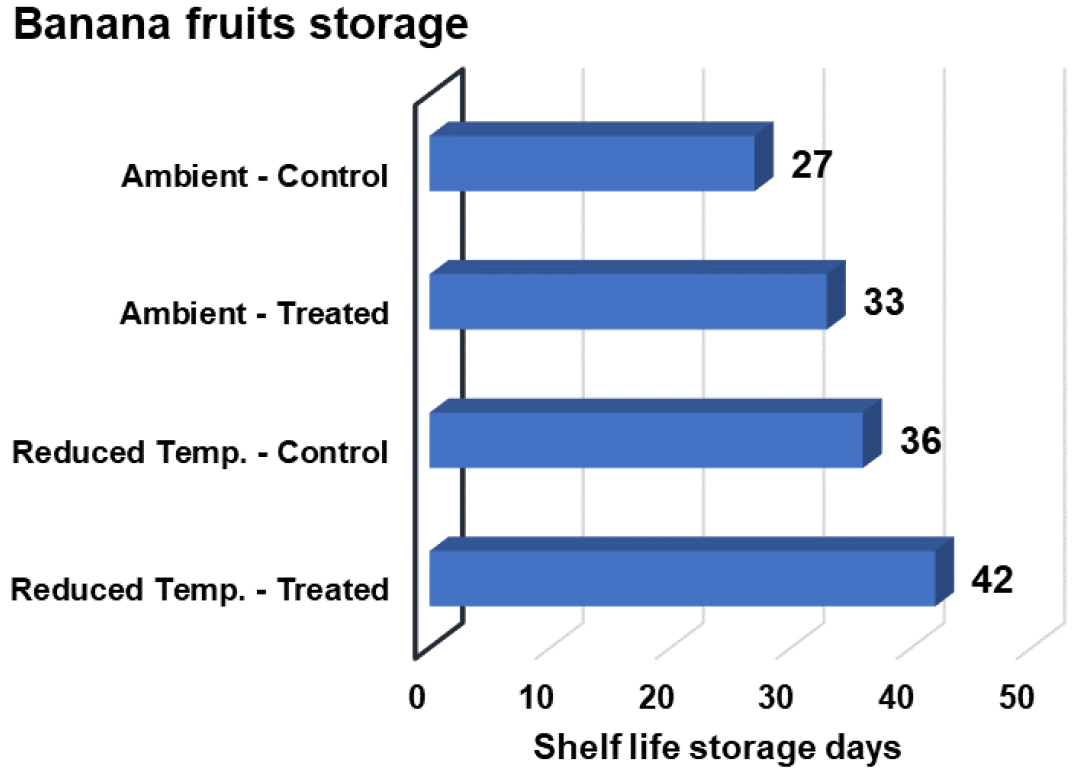
Fig. 1.
Shelf-life of bananas treated with EFF and the control at 85% maturity under ambient and reduced-temperature conditions (Venkatachalam et al., 2018).
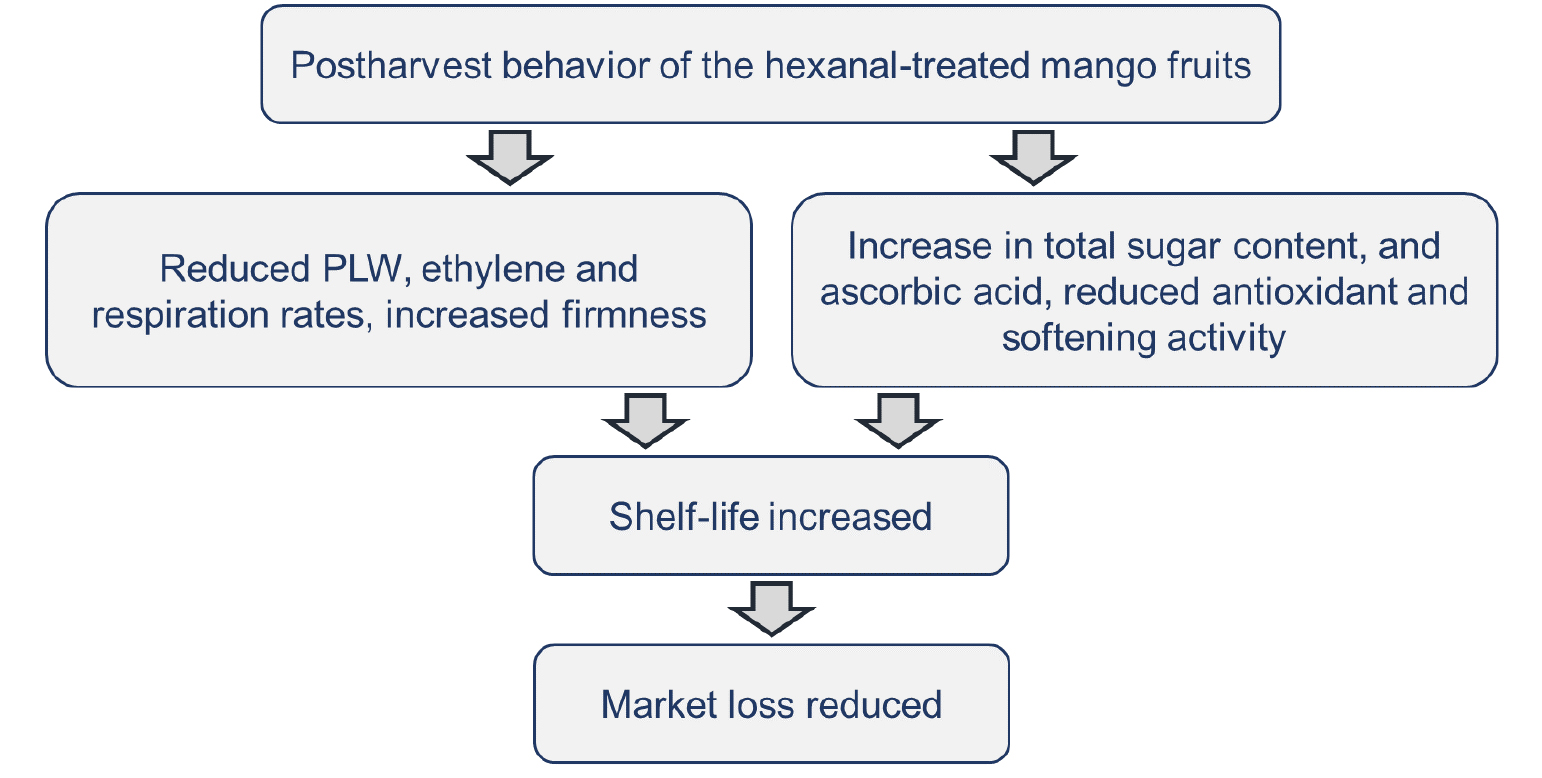
Similarly, an investigation by Preethi et al. (2018) examined the effects of hexanal formulations on the shelf-life of two mango cultivars, Banganapalli and Alphonso. The results demonstrated that under ambient storage conditions, shelf-life was extended to 8-9 days, and under cold storage conditions, it reached 18-20 days. In comparison, control fruits could be stored for up to 5 days in ambient conditions and 12 days in cold storage for both cultivars. Apart from prolonging shelf-life, hexanal formulations positively impacted firmness, weight loss, total soluble solids, and total sugar content of the fruits. These findings align with previous reports by Spotts et al. (2007), Boukobza and Taylor (2002), and Lanciotti et al. (2003) on the significant improvement in postharvest quality of perishable crops achieved through hexanal nanotechnology. The investigation is summarized in Fig. 2.
Effectiveness of hexanal nanotechnology in extending shelf-life and preserving quality attributes
Hexanal nanotechnology is highly effective in increasing the shelf-life of various fruits and vegetables while preserving their quality (Li et al., 2011). Numerous studies have reported reductions in spoilage, decay, and microbial growth, resulting in longer freshness and improved sensory characteristics. Shi et al. (2013) reported that hexanal nanotechnology helps to keep the nutritional content of produce by minimizing the loss of nutrients during storage and transportation. Other examples of successful hexanal nanotechnology applications include extending the storage life and preserving the quality of bananas, tomatoes, strawberries, apples, green soybeans, cucumber, carrot, papaya, wine grapes, etc. In these studies (Table 2), hexanal nanotechnology in forms of nanocoating, nano-emulsions, vapor spray, and enhanced freshness formulations (EFF) was applied to the surface of produce, resulting in delayed ripening, reduced microbial growth, and improved overall quality during storage.
Table 2.
Highlights of the application of hexanal nanotechnologies in fruit and vegetable preservation.
| Product | Hexanal nanocomponents | Effects | References |
| Apple | Nano-ZnO | Fresh-cut apples packed with nano-packaging had a storage period extended by 6 days compared to those packed with traditional polyvinyl chloride film. | Li et al., 2011 |
| Cortland apples | Nano formulation | Under 6 months of storage, control apples had over 95% scald, while those treated with hexanal had less than 5% scald. | Padmanabhan and Paliyath 2018a |
| Cucumber | Chitosan | Chitosan nanoparticles coating on cucumber boosted antioxidant activity and prolonged storage period. | Mohammadi et al., 2015 |
| Guava fruits | EFF | Hexanal-EFF was effective in improving guava quality during cold storage. It reduces decay, weight loss, and enhances quality | Gill, 2018 |
| Papaya | C6H12O | After 5 days of hexanal dip treatment, anthracnose symptoms on papaya were inhibited compared to untreated samples. | Hewajulige et al., 2018 |
| Mango | Nanofiber matrix | The hexanal nano fibre matrix prolonged the shelf-life of mango fruits for up to 14 days under ambient condition while the control stayed only 6 days. Quality parameters of the fruits were also preserved. | Gbabe et al., 2025 |
| Kiwifruit | Nano-ZnO | Kiwifruit products coated with nano Zinc Oxide had a lower ethylene content, less water loss, and kept their texture compared to the control samples. | Meng et al., 2014 |
| Orange varieties | Hexanal spray | When used as a pre-harvest spray, hexanal increased marketable fruits by 34.89%, 34.04%, and 42.48% in Early Valencia, Jaffa, and Late Valencia varieties, respectively. | Samwel et al., 2020 |
| Longan fruit | Nano-silica | Nano Silica reduced the activity of enzymes and improved nutrient retention, (total soluble solids and vitamin C) compared to the control treatment | Shi et al., 2013 |
| Banana | C6H12O | Fresh-Hexanal postharvest dip extended the shelf-life of banana varieties by 9 days (Grand Nain) and 6 days (sweet), and improved quality parameters compared to control. | Yumbya et al., 2018 |
| Pomegranate | Nano-ZnO | Nanoscale coating could reduce the quantity of yeast, mold, and weight loss | Saba and Amini, 2017 |
| Wine Grape | C6H12O | After cold storage for five weeks, the grapes treated with hexanal formulations were still fresh and shiny as compared to control | Oke et al., 2018 |
| Carrot | Nano-ZnO | Nano-ZnO was effective in reducing the total colony forming units during storage, extending the shelf-life to 40 days. | Xu et al., 2017 |
| Honeycrisp apples | Hexanal formulations | After 150 days, treated apples showed higher quality, reduced pathogen infections (mold and scab) than the control. | Padmanabhan and Paliyath, 2018b |
| Green soybean | Nano-ZnO | Nano-ZnO significantly inhibits the growth of common microorganisms, including bacteria, coliforms, yeast, and molds. | Yu et al., 2015 |
| Tomato | EFF-hexanal | Hexanal- EFF-dipped tomatoes showed good color, firmness, and appearance. The control was overripe, soft and spoilage was seen. | Padmanabhan et al., 2018 |
| Strawberries | Nano-ZnO | Strawberries coated with nano-ZnO showed inhibited microbial growth, delayed weight loss, and kept functional nutrients. | Sogvar et al., 2016 |
| Sweet cherries | EFF | Besides increasing the shelf-life, the treated sweet cherries displayed better appearance, firmness, flavor, and sweetness after the storage period. | Padmanabhan et al., 2018 |
| Tomato | Hexanal powder | At temperature of 20°C, the treated tomatoes are stored for (28 days) while the untreated stored for 12 days. | Chavan and Sakhale, 2019 |
Advantages and Current Challenges of Hexanal Nanotechnology
Hexanal nanotechnology has revolutionized many industries, including agriculture by providing new ways to preserve fruits and vegetables. This section highlighted the benefits and challenges of hexanal nanotechnology, as well as proposed a solution to the current challenges.
Advantages
The advantage of hexanal nanotechnology cannot be overemphasized when it comes to preserving fruits and vegetables. Technology maintains stability and preserves its antimicrobial and antioxidant properties by creating a protective matrix that safeguards its effectiveness over time (Xu et al., 2017). The use of nanocarriers allows for a controlled release of hexanal, which contributes to a sustained protective effect. This approach is also environmentally friendly, offering a greener alternative to conventional chemical preservatives by reducing environmental impact and residue levels (Samwel et al., 2020). Additionally, nanoparticles can easily be infused into fruits through nano-packing, where the fruit is wrapped in a material containing nanoparticles on its surface (Preethi et al., 2018), allowing for easy absorption and efficient shipping to their destination while keeping the nutritional quality. This innovative approach not only minimizes post-harvest losses but also contributes to economic benefits for farmers by increasing the income generated per hectare and reducing food waste, ultimately benefiting both producers and consumers alike.
Current challenges
Hexanal nanotechnology, despite its potential for improving fruit and vegetable quality and shelf-life, still faces some challenges. The development and implementation of this technology can be costly, requiring substantial initial investments compared to traditional preservation methods. Incorporating hexanal into nanomaterials requires specialized ability in areas such as nanomaterials, formulation chemistry, and food science, which adds technical complexity (Gill, 2018). Obtaining regulatory approval and conducting safety assessments are necessary steps to ensure the safety of this technology for widespread adoption in food products. Consumer acceptance, influenced by beliefs of nanotechnology in food items, is another critical factor that must be considered (Padmanabhan et al., 2018). Addressing these challenges and limitations is essential to maximizing the potential of hexanal nanotechnology in the preservation of fruits and vegetables.
Addressing the challenges
To overcome the constraints of hexanal nanotechnology, a comprehensive approach that considers current research findings should be adopted. Firstly, it is essential to manage costs by refining development and implementation expenses through exploring more cost-effective production methods, perfecting manufacturing processes, and seeking funding opportunities to support further research and development (Oke et al., 2018). Secondly, enhancing technical ability in nanomaterials, formulation chemistry, and food science is crucial to navigate the intricate technical aspects. Investing in research initiatives and training programs can cultivate the necessary skills for integrating hexanal into nanomaterials (Saba and Amini, 2017). Yumbya et al. (2018) also suggested streamlining regulatory approval processes and safety assessments to ease the widespread adoption of hexanal nanotechnology in food products. Collaborating with regulatory bodies and adhering to established guidelines can enhance the path to market entry. Additionally, educating consumers about the benefits and safety of hexanal nanotechnology in food preservation is key to building consumer trust and fostering market adoption (DeBrouwer et al., 2020). If these critical issues are fully addressed, the difficulties and limitations of hexanal nanotechnology can be effectively overcome, allowing for the successful implementation of this technology in the fruit and vegetable industry.
Environmental Impact of Hexanal nanotechnology
While research on the toxicity, consumer safety, and environmental impact of hexanal and various nanomaterials is still in its early stages, several studies have highlighted their compatibility with the environment and ecosystems.
Biosafety
Biosafety is a critical aspect of nanoproducts, as it aims to prevent adverse effects on non-target organisms and humans. Biosafety refers to any activity that aims to safeguard a population from the harmful effects of biological materials or agents and minimize their environmental impact (Gómez-Tatay and Hernández-Andreu, 2019). Hexanal, when synthetically produced with adjuvants and surfactants, requires biosafety tests to evaluate its impact on organisms and the environment (The Organization for Economic Co-operation and Development, OECD, 2023). Studies have shown that hexanal and its carriers are biodegradable and do not pose a threat to the environment, making them safe for use (Karthika et al., 2015). This is because hexanal dissipates quickly when applied as a vapor, breaking down into harmless components such as hexanoic acid. Honeybees are widely recognized as an indicator of biosafety for new chemicals or formulations, and testing chemicals for their safety against honeybees is a prerequisite (Kruse et al., 2006). The results of studies conducted to evaluate the toxicity of hexanal nanotechnology showed that it is safe for honeybees, beneficial microbes, natural enemies, earthworms, human cell lines, and zebra fish (Mohan et al., 2017). Therefore, the biodiversity of the orchard ecosystem is conserved without adverse effects.
Biodegradability
Hexanal, when used in a nanotechnology framework, undergoes rapid biodegradation into non-toxic components under ambient environmental conditions. Experimental studies demonstrated that its chemical structure facilitates easy breakdown in soil and aqueous systems without releasing harmful metabolites (Osman, 2019; Mehta et al., 2024). These degradation processes reduce the environmental risk typically associated with synthetic preservatives, aligning with global efforts to mitigate ecological contamination from industrial chemicals.
Minimal residue
A key environmental merit of HNT is the production of negligible residues after application. Unlike synthetic preservatives that leave persistent by-products, hexanal has been shown to degrade efficiently, with minimal residues left in food matrices and agroecosystems (Kumar et al., 2023). The minimal residue profile reduces concerns related to bioaccumulation and adverse impact on soil and water quality.
Non-toxicity to non-target organisms
Toxicological assessments have ascertained that HNT formulations do not exhibit harmful effects on non-target organisms. Pollinators, beneficial soil microbes, and other vital components of the ecosystem were unaffected by hexanal exposure (Osman, 2019). This characteristic is particularly important, considering the role these organisms play in maintaining ecological balance and effective nutrient cycling (Ferreira et al., 2013). The absence of adverse effects highlights the position of hexanal nanotechnology as an environmentally friendly preservative.
Sustainable alternative
Besides low eco-toxicity and residue concerns, hexanal nanotechnology contributes to a sustainable food preservation paradigm. It reduces the dependence on traditional chemical preservatives and refrigeration technologies, thereby reducing energy consumption and chemical load associated with conventional practices (Liu et al., 2015). Savings in energy and resources translate into a lower carbon footprint, making HNT a good option for retailers and producers aiming to implement eco-friendly preservation systems (Nuruzzaman et al., 2016).
Future Research Direction
To maximize the potential of hexanal nanotechnology, additional research is necessary to refine formulations tailored to specific fruits and vegetables, focusing on factors such as stability, efficacy, and sensory acceptability. Collaboration among experts in nanotechnology, engineers, and food industry professionals is essential for driving innovation in this area and developing customized solutions for different food matrices. Additionally, exploring the integration of hexanal nanotechnology with smart packaging technologies can enable real-time monitoring of food quality and safety, fostering consumer confidence and reducing food waste. More so, more efforts should be put into addressing safety concerns and regulatory considerations associated with hexanal nanotechnology in food applications through rigorous safety assessments and transparent communication with regulatory agencies. Constructive interaction between industry, academia, and government entities can facilitate technology transfer and accelerate market adoption. Lastly, scaling up production for commercial applications and upskilling farmers, particularly in developing countries where significant losses and waste occur in the fruit and vegetable supply chain, will be a game-changer for food security in those countries.
Recommendations and strategies for implementation
The adoption of Hexanal Nanotechnology presents a good opportunity for reducing postharvest losses of fruits and vegetables, particularly in developing countries. Given its effectiveness in extending shelf-life and maintaining quality, adopting HNT in developing countries could be a game-changer in agricultural sustainability. For instance, Nigeria faces significant postharvest losses in fruits and vegetables due to inadequate storage infrastructure, poor transportation networks, and a lack of effective preservation methods. Approximately 40-50% of fruits and vegetables produced in Nigeria are lost due to inadequate handling and storage systems, poor packaging, and the absence of processing facilities. These directly impact poor producers through foregone income and impact poor consumers by reduced food availability, increased prices, and decreased nutritional content. Integrating HNT into the country’s agricultural value chain can assist farmers in minimizing waste, enhancing profitability, and ensuring a more stable and secure supply of fruits and vegetables. To ensure the successful adoption of HNT, the following strategies are recommended.
Efforts that evaluate their effectiveness under unique environments and agricultural practices should be put in place. This involves conducting local studies on major fruit and vegetable crops produced in a country to determine how HNT influences their shelf-life and quality. Also, pilot programs should be established in key agricultural regions to test the application on commonly cultivated produce such as tomatoes, mangoes, cucumbers, peppers, and bananas. These initiatives will provide valuable insights into real-world performance and determine the best practices. Collaborations with universities, agricultural research institutes, and international partners will be key in knowledge sharing, technical support, and validation of research findings. This will lay a strong foundation for decision-making and policy development.
To promote the adoption of HNT, it is important to develop a comprehensive policy framework that supports the integration of nanotechnology in agriculture, with a focus on postharvest management. Governments should provide targeted incentives such as tax reliefs, subsidies, or grants to encourage local production, distribution, and utilization. Additionally, regulatory bodies should work to facilitate the approval, quality control, and standardization of hexanal-based formulations to ensure their safety, efficacy, and public acceptance. These measures will create an enabling environment for innovation, investment, and adoption.
Establish centralized storage facilities equipped with HNT application zones in key agricultural production areas to enhance postharvest handling and preservation. Strengthen transportation logistics to ease the movement of treated produce from farms to market to minimize spoilage during transit. More so, supporting the local development of HNT formulation and packaging centres can improve accessibility, and consistent supply to farmers and agribusinesses.
Training workshops and extension services should be organized for farmers, cooperatives, and agribusiness owners. This will equip them with the knowledge of the science behind HNT, application techniques (spray, coating, deep, etc), safety, and environmental handling. Additionally, farmer field schools or demonstration centres should be created to show practical application and resulting effects.
Support public-private partnerships, investment from agribusinesses and startups to encourage scaling up, distribution and the transfer of technology across the fruits and vegetables value chain.
Set up a robust monitoring and evaluation plan to assess the economic, environmental, and social impacts of implementing HNT. findings from the evaluation can guide the scaling up of effective pilot programs across a country, with a focus on regions most affected by postharvest losses.
Conclusion
This article provides an overview of hexanal nanotechnology and its applications in preserving fruits and vegetables to reduce postharvest losses and enhance food quality and availability. The review examined previous studies where hexanal nanotechnology was successfully applied to extend the storage life of fruits and vegetables over a considerable period. Through the targeted and controlled release of antimicrobial and antioxidant compounds, hexanal nanotechnology effectively extends shelf-life, enhances stability, reduces environmental impact, and preserves the nutritional quality of fruits and vegetables. Its potential to revolutionize fruit and vegetable preservation presents it as a reliable alternative to conventional preservation techniques. Recommendations and strategies for implementing pilot-scale plans for potential adoption in developing countries, where postharvest losses are a major challenge, were also presented.