


Introduction
Upland row crops and disease classification
Disease classification by location, timing, and economic damage
Proximal and remote sensing technologies for diseases detection
Machine learning and deep learning for disease diagnosis
Precision chemical application technologies
Variable rate technology
Challenges and future research
Conclusions
Introduction
Upland row crops are cultivated in non-flooded, well-drained soils and typically grown in rows to facilitate mechanized agricultural operations such as planting, fertilization, irrigation, crop protection, and harvesting. Major upland row crops include maize (Zea mays L.), soybean (Glycine max L.), wheat (Triticum aestivum L.), potato (Solanum tuberosum L.), cotton (Gossypium hirsutum L.), peanut, sorghum (Sorghum bicolor L.) and pepper (Capsicum annuum L.) (Smith, 2023). These crops form the backbone of global food, feed, fiber, and industrial supply chains, with extensive cultivation across North America, South America, Europe, Asia, and Africa underpinning global food, livestock feed, textile fiber, and industrial supply chains (Kim et al., 2023).
Based on their primary harvested products, upland crops can be broadly classified into vegetable crops, such as pepper and other fruit vegetables, grain crops including maize, wheat, soybean, and peanut, root and tuber crops, such as potato, sweet potato, and fiber crops, such as cotton. Modern production systems rely on high-density planting, synthetic fertilization, irrigation, and chemical crop protection, practices that have substantially increased productivity but also intensified the emergence and spread of plant pathogens (Savary et al., 2019). Compounding this, climate change-driven shifts in temperature, humidity, and rainfall are amplifying disease pressure across many agricultural regions.
Among biotic stresses, foliar diseases are particularly destructive because leaf infections directly impair photosynthesis, carbon assimilation, and transpiration, ultimately reducing biomass accumulation and grain yield. Under severe epidemic conditions, soybean rust alone can reduce yield by more than 80% (Wrather and Koenning, 2006; Bilgin et al., 2010), while potato late blight can destroy entire fields within weeks under cool, humid conditions (Fry, 2008). Northern corn leaf blight and gray leaf spot significantly reduce photosynthetic efficiency in maize (Mueller et al., 2016), and emerging races of wheat rust continue to threaten global wheat production (Dean et al., 2012). Collectively, annual crop losses attributable to plant diseases are estimated to exceed hundreds of billions of dollars worldwide (Savary et al., 2019).
Conventional crop protection relies primarily on calendar-based, uniform pesticide application regardless of actual spatial disease distribution or severity (Mulla, 2013). This approach leads to excessive agrochemical use, elevated production costs, environmental contamination, and accelerated development of resistant pathogen populations (Popp et al., 2013). This blanket spraying fails to account for the inherently heterogeneous nature of disease distribution within fields, where outbreaks frequently occur as localized hotspots driven by canopy density, soil moisture variability, microclimatic conditions, and pathogen inoculum concentration (Gebbers and Adamchuk, 2010).
Precision agriculture addresses these limitations by integrating sensing technologies, geographic information systems, remote sensing platforms, artificial intelligence, and automated spraying systems to enable site-specific disease detection and targeted chemical application (Gebbers and Adamchuk, 2010; Li et al., 2024). This approach optimizes pesticide use by applying inputs only where and when disease pressure warrants intervention. Leaves are the primary targets for disease monitoring because pathogen infection induces measurable changes in chlorophyll content, canopy temperature, leaf water status, and photosynthetic efficiency often before visible symptoms appear (Mahlein, 2016; Prashar and Jones, 2014). Advances in RGB, multispectral, hyperspectral, and thermal imaging, combined with machine learning and deep learning algorithms, have substantially improved the capacity to detect disease-related physiological stress under field conditions (Barbedo, 2019; Kamilaris and Prenafeta-Boldú, 2018). In large-scale upland crops where manual scouting is labor-intensive and spatially inconsistent, these technologies offer a transformative pathway to improving disease-management efficiency while reducing environmental burden (Sun et al., 2022).
This review specifically focused on pepper, potato, and major grain crops (maize, wheat, soybean), while also drawing on recent advances in disease detection and precision crop protection relevant to other upland crops such as cotton and peanut to provide a balanced perspective. Unlike previous reviews that largely address disease detection and precision spraying separately, this review integrates these components within a unified crop-protection framework. Accordingly, the objective of this review was to integrate recent advances in disease detection and precision chemical application technologies for upland row crops, with emphasis on leaf-level sensing, imaging-based detection systems, machine learning and deep learning approaches, variable-rate and sensor-based spraying technologies, robotic application systems, and the key challenges limiting practical field-scale deployment.
Upland row crops and disease classification
Upland row crops are field crops cultivated under non-flooded, well-drained soil conditions using mechanized row-based production systems that enable mechanized planting, fertilization, chemical application, and harvest. They are distinguished from lowland or paddy crops primarily by their soil moisture management requirements and by their dependence on rainfed or supplementary irrigation rather than continuous flooding. They are widely grown across major agricultural regions, including North and South America, Europe, Asia, and sub-Saharan Africa. They contribute substantially to global food, vegetable, fiber, feed, and industrial production. However, pathogens and pests cause considerable losses in major upland crops, including wheat, maize, potato, and soybean, highlighting the importance of effective disease monitoring and management technologies (Savary et al., 2019). Based on their primary harvested products and agricultural uses, the crops considered in this review are classified as vegetable crops, grain crops, root and tuber crops, and fiber or industrial crops. These crop groups differ in canopy structure, field arrangement, harvested plant organ, and disease expression. Therefore, disease-detection and precision chemical-application systems must be adapted to the characteristics of each crop category.
Upland vegetable crops include pepper and other vegetables cultivated in open fields, on ridges, or under protected production systems. Pepper (Capsicum annuum L.) is classified as a fruit vegetable because the fruit is the primary harvested product and is commonly grown in structured rows, making them suitable for machine-vision monitoring, robotic scouting, UAV imaging, and precision spraying. Pepper plants are affected by several economically important diseases, including bacterial spot, anthracnose, Phytophthora blight, powdery mildew, fruit rot, and viral diseases. As shown in Table 1, symptoms may occur on leaves, stems, roots, and fruits and include leaf spots, chlorosis, wilting, stem or root rot, and fruit lesions. Bezabh et al. (2023b) developed a concatenated CNN model for classifying multiple pepper leaf and fruit diseases, demonstrating the applicability of RGB imaging and deep learning to automated pepper disease diagnosis. Duan et al. (2024) further showed that multispectral imaging combined with spectral–textural feature fusion and CNN models could detect pepper Phytophthora blight before visible symptoms appeared. The overlapping leaves, fruits, and branches of pepper plants can obscure disease symptoms and restrict chemical penetration into the lower canopy. Consequently, pepper disease-management systems require accurate disease localization, canopy-aware nozzle control, and spraying strategies that provide adequate coverage of leaves, stems, and fruits.
The grain crops considered in this review include maize, wheat, soybean, and peanut. Maize and wheat are classified as cereal crops, whereas soybean and peanut are grain-legume and oilseed crops. These crops are commonly cultivated over large areas using mechanized planting, spraying, and harvesting systems. Major diseases include northern corn leaf blight and rust in maize, powdery mildew and Fusarium head blight in wheat, bacterial blight and sudden death syndrome in soybean, and leaf spot and rust in peanut. These diseases can reduce photosynthetic leaf area, disrupt plant development, reduce grain quality, and cause substantial yield losses, also it can be detected and analysed using remote monitoring sensors as summerized in Table 1. Savary et al. (2019) identified considerable global yield losses associated with pathogens and pests in maize, wheat, and soybean production. The extensive and relatively uniform cultivation patterns of grain crops make them suitable for UAV-based imaging, multispectral monitoring, and large-scale disease mapping. At the individual-plant or leaf level, CNN-based models can support disease classification and localization. For example, Pan et al. (2022) applied deep convolutional neural networks to northern corn leaf blight diagnosis, demonstrating the potential of image-based models for automated maize disease recognition. Potato (Solanum tuberosum L.) is classified as an upland tuber crop because its economically important harvested organs develop below the soil surface. Nevertheless, important diseases such as late blight and early blight initially produce visible symptoms on leaves and stems. Typical symptoms include chlorotic or necrotic leaf lesions, stem infection, canopy wilting, premature defoliation, and eventual tuber rot (Dutta et al., 2024). As shown in Table 1, potato disease symptoms extend from above-ground tissues to the harvested organ, including leaf spots, stem blight, and tuber rot. This differs from the predominantly foliar symptoms reported for several grain crops and emphasizes the importance of detecting canopy symptoms early, before disease progression causes substantial tuber damage.
Disease monitoring in potato therefore commonly relies on above-ground canopy observations using RGB, multispectral, hyperspectral, thermal, and UAV-based imaging. Rodríguez et al. (2021a) used UAV-acquired multispectral images and machine-learning algorithms to detect and map potato late blight under field conditions, demonstrating the potential of remote sensing for disease assessment with reduced dependence on manual scouting. Root and tuber crop monitoring must also consider soil moisture, drainage, temperature, and soil-borne pathogen distribution because below-ground conditions substantially influence disease initiation and development. Sensor fusion combining canopy imagery with soil and environmental measurements could therefore improve early disease-risk assessment.
Cotton (Gossypium hirsutum L.) is classified as an upland fiber and industrial crop. It is cultivated primarily for lint production, while cottonseed is also used for oil and animal-feed products. Important diseases include Verticillium wilt and bacterial blight, which may cause leaf chlorosis, wilting, vascular browning, defoliation, reduced boll development, and decreased fiber yield. Large cotton fields are suitable for UAV-based disease mapping, multispectral imaging, hyperspectral sensing, and variable-rate chemical application. Ma et al. (2024) combined UAV-based multispectral and RGB imagery with vegetation indices, color indices, texture features, and machine-learning models to estimate the severity of cotton Verticillium wilt. Their findings showed that multisource feature fusion improved disease-severity monitoring compared with using a single feature category. The differences among vegetable, grain, root or tuber, and fiber crops influence the selection of sensors, imaging platforms, detection algorithms, and pesticide-application systems.
Mechanized operations including planting, cultivation, spraying, and harvesting are standard practice, making them compatible with precision technology integration. High-input production systems, including synthetic fertilization and irrigation, further accelerate vegetative growth and create dense canopies with elevated humidity, favoring fungal and bacterial pathogen development. The combination of large field scale, crop density, and high-value production makes efficient disease monitoring and targeted chemical application economically critical in these systems. Fig. 1 shows different upland row crops disease classification and Table 1 summarizes major upland crops, common diseases, symptoms, and their detection approaches.
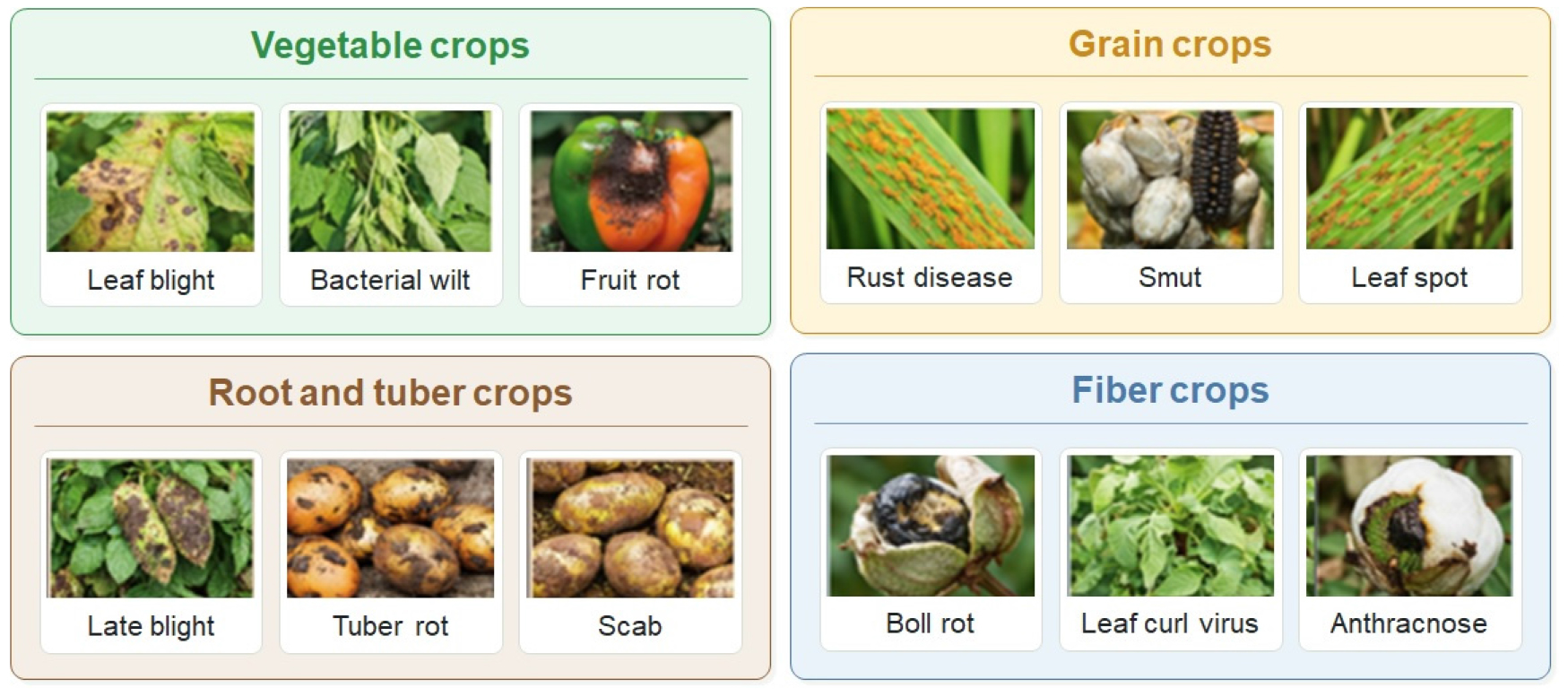
Table 1
Classification of major upland row crops and summary of their common diseases, characteristic symptoms, and precision sensing and detection approaches.
| Crop | Crop group | Major diseases | Pathogen type | Key symptom | Detection method | References |
| Maize | Cereal crop |
Northern leaf blight; rust | Fungal |
Leaf lesions, chlorosis, reduced photosynthesis |
Multispectral imaging; CNN-based classification | Mueller et al., 2016; Savary et al., 2019 |
|
Soy bean |
Grain legume / oilseed |
Bacterial blight; sudden death syndrome |
Bacterial; fungal |
Chlorosis, necrosis, stem discoloration |
Hyperspectral imaging; thermal stress mapping | Wrather and Koenning, 2006; Mahlein, 2016 |
| Wheat | Cereal crop |
Powdery mildew; Fusarium head blight | Fungal |
White patches, head discoloration, grain shriveling |
RGB–hyperspectral fusion; deep learning | Dean et al., 2012; Savary et al., 2019 |
| Potato | Tuber crop |
Late blight; early blight |
Oomycete; fungal |
Leaf spots, stem blight, tuber rot |
UAV imaging; AI-based segmentation | Fry, 2008; Sun et al., 2022 |
| Cotton | Fiber crop |
Verticillium wilt; bacterial blight |
Fungal; bacterial |
Wilting, vascular browning, defoliation |
Thermal imaging; multispectral mapping; variable-rate spraying | Li et al., 2024 |
| Peanut |
Grain legume / oilseed | Leaf spot; rust | Fungal |
Leaf lesions, defoliation, yield reduction |
Multispectral imaging; sensor-based detection | Culbreath et al., 2002 |
| Pepper | Fruit vegetable |
Bacterial spot; anthracnose; Phytophthora blight; powdery mildew; mosaic virus |
Bacterial; fungal; oomycete; viral |
Leaf and fruit lesions, wilting, mosaic symptoms, stem/root rot |
RGB imaging; CNN/YOLO detection; multispectral and thermal sensing | Bezabh et al., 2023b; Duan et al., 2024; Zhang et al., 2025 |
Disease classification by location, timing, and economic damage
Plant diseases in upland row crops can be classified according to the infected plant organ, the stage of crop development at which infection occurs, and the resulting agronomic and economic damage. Fungal, bacterial, viral, and oomycete pathogens may infect leaves, stems, vascular tissues, roots, tubers, fruits, or reproductive organs. Because these organs differ in physiological function, anatomical structure, and exposure to environmental conditions, disease symptoms and their effects vary considerably among crop groups (Kobayashi et al., 2022). Consequently, disease-monitoring systems should be selected according to the crop type, target organ, symptom-development stage, and expected economic impact. Imaging technologies, artificial intelligence, robotics, and autonomous sensing platforms have increasingly enabled organ-specific disease monitoring under both controlled and field conditions (Kamilaris and Prenafeta-Boldú, 2018).
In upland vegetable crops such as pepper (Capsicum annuum L.), diseases may affect leaves, stems, crowns, roots, and fruits. Foliar diseases commonly produce chlorosis, necrotic lesions, mosaic patterns, mildew growth, leaf curling, and premature defoliation. Important pepper diseases include bacterial spot, anthracnose, powdery mildew, Phytophthora blight, Fusarium wilt, and viral diseases. Symptoms may initially appear as small lesions or discoloration on the leaves and subsequently develop on stems or fruits. Foliar infection reduces the effective photosynthetic area and plant vigor, whereas fruit infection directly reduces marketable yield and quality (Bezabh et al., 2023b; Liu and Wang, 2024).
Stem, crown, and vascular diseases can disrupt water and nutrient transport, resulting in stem discoloration, cankers, wilting, reduced growth, and eventual plant collapse. Phytophthora blight commonly begins around the root or crown region, where early infection may remain concealed by soil and canopy structure. Duan et al. (2024) demonstrated that multispectral imaging combined with spectral-textural feature fusion and convolutional neural networks could detect pepper Phytophthora blight before visible symptoms developed. This finding illustrates the value of physiological and spectral measurements for identifying diseases that cannot be reliably recognized through conventional visual inspection during their early stages. The timing of disease development strongly affects economic loss in pepper production. Infection during vegetative growth can restrict canopy establishment, whereas infection during flowering, fruit setting, and fruit development can directly reduce fruit number, fruit size, appearance, and storage quality. Even when total plant biomass is not substantially reduced, lesions, deformation, discoloration, and decay can make pepper fruits unsuitable for fresh-market or processing purposes.
Disease detection in vegetable crops therefore requires monitoring multiple plant organs. RGB imaging is suitable for identifying visible leaf and fruit symptoms, while multispectral, hyperspectral, and thermal imaging can reveal physiological changes associated with infection before or alongside visible symptom development (Mahlein, 2016). Close-range cameras and ground-based robotic platforms are particularly relevant to pepper because small symptoms, overlapping leaves, complex backgrounds, and canopy occlusion can limit detection from overhead or aerial images. Recent pepper-detection research has specifically identified small target size, symptom similarity, background complexity, and leaf occlusion as major technical challenges (Liu and Wang, 2024).
The grain crops considered in this review include maize, wheat, soybean, and peanut. Maize and wheat are cereal crops, whereas soybean and peanut are grain legumes that are also widely classified as oilseed crops. Foliar diseases are economically important in these crops because they reduce green leaf area, photosynthesis, canopy development, and assimilate production required for grain or seed formation. Globally, pathogens and pests are responsible for substantial yield and quality losses in major crops, including wheat, maize, and soybean (Savary et al., 2019).
Major foliar diseases include soybean rust caused by Phakopsora pachyrhizi, northern corn leaf blight caused by Exserohilum turcicum, gray leaf spot caused by Cercospora zeae-maydis, wheat powdery mildew caused by Blumeria graminis, stripe rust caused by Puccinia striiformis, and peanut leaf spot caused by Cercospora arachidicola. Their characteristic symptoms include chlorosis, necrotic lesions, elongated or circular leaf spots, rust pustules, mildew formation, and premature defoliation. Northern corn leaf blight and gray leaf spot, for example, are important foliar diseases that can cause considerable maize yield losses when infection develops before or during critical reproductive stages (Mueller et al., 2016).
Stem and vascular diseases also cause significant damage in grain crops. Soybean stem canker caused by Diaporthe species and maize stalk rot associated with Fusarium and Gibberella species can weaken structural tissues, interfere with vascular transport, and increase lodging risk (Xue et al., 2021). These diseases are more difficult to detect using overhead imagery because the affected stems are frequently concealed by leaves and neighbouring plants. Consequently, proximal imaging, side-view cameras, thermal sensing, and mobile robotic platforms may be needed to complement UAV-based canopy monitoring.
The timing of infection is a major determinant of economic loss. Early vegetative infection can restrict canopy establishment and biomass accumulation, whereas disease development during flowering, grain filling, or seed development can directly reduce grain number, seed weight, and product quality. Stem and stalk diseases developing near maturity may also increase lodging and mechanical harvesting losses. Therefore, disease severity should be interpreted together with crop-growth stage rather than through symptom area alone. Large-scale grain fields are well suited to UAV-based RGB and multispectral imaging, thermal stress mapping, and spatial disease-risk modelling. These technologies can rapidly monitor relatively uniform crop canopies and identify spatial differences in disease severity. Deep learning can further support automated symptom classification and localization, although field performance remains affected by illumination, cultivar, canopy density, disease stage, and symptom similarity (Kamilaris and Prenafeta-Boldú, 2018; Mahlein, 2016).
In root and tuber crops such as potato (Solanum tuberosum L.), disease classification must consider both above-ground and below-ground plant organs. Although tubers are the economically harvested products, many important diseases initially become visible on leaves and stems. Potato late blight caused by the oomycete Phytophthora infestans and early blight caused by the fungus Alternaria solani commonly produce chlorotic or necrotic lesions, canopy blighting, stem infection, and premature defoliation. These symptoms reduce photosynthetic capacity and limit carbohydrate production and translocation to developing tubers.
Stem and vascular infection may interfere with water and assimilate transport and accelerate canopy collapse. Below-ground infections can result in tuber discoloration, surface lesions, soft or dry rot, and reduced storage quality. However, direct optical detection of underground symptoms is difficult because the affected organs are covered by soil. Disease monitoring therefore commonly relies on indirect above-ground indicators, including canopy color, temperature, vegetation indices, wilting, and growth reduction, together with soil and environmental measurements.
The timing of disease development is particularly important in potato production. Early foliar infection can restrict canopy establishment and tuber initiation, whereas infection during tuber bulking can reduce tuber size and total yield. Late-season infection may increase the transfer of inoculum from infected foliage to tubers, resulting in postharvest deterioration and storage losses. Consequently, both disease onset and disease progression should be monitored throughout the crop-development period.
RGB imaging can identify visible late-blight lesions, while multispectral and hyperspectral imaging can detect changes extending beyond the visible spectrum. Rodríguez et al. (2021a) demonstrated the use of UAV-based multispectral imagery and machine-learning algorithms to detect and map potato late-blight occurrence under field conditions. Deep learning has also been applied to recognize late-blight lesions and quantify disease severity from field images of diverse potato genotypes (Gao et al., 2021).
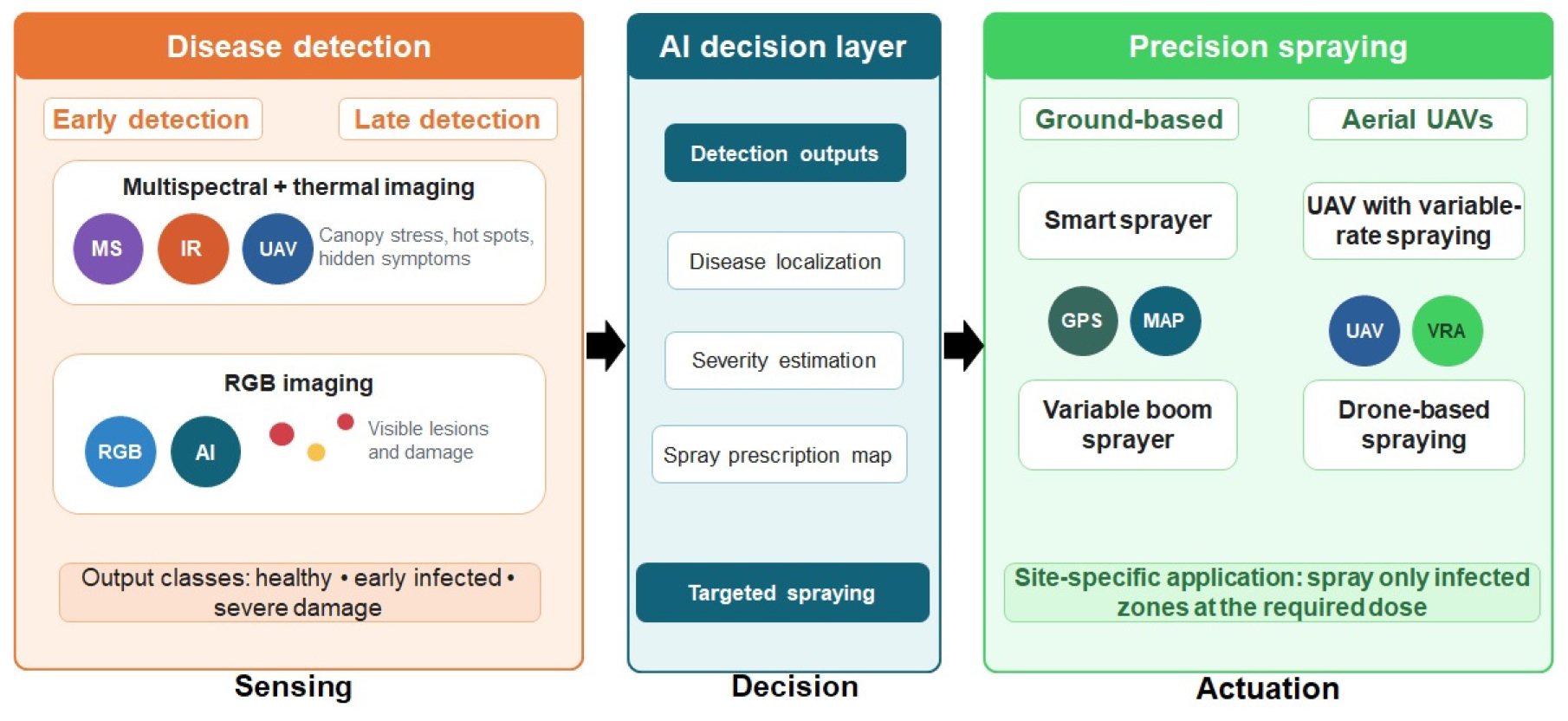
Effective disease-risk assessment in root and tuber crops should combine canopy imagery with environmental and soil information, including temperature, rainfall, relative humidity, leaf-wetness duration, soil moisture, and drainage conditions. Such integration is especially important for oomycete and fungal diseases whose infection, sporulation, and dispersal are strongly influenced by moisture and temperature. Across vegetable, grain, and root or tuber crops, environmental conditions strongly influence disease initiation, spread, and severity. Temperature, humidity, rainfall, leaf-wetness duration, soil moisture, and canopy density should therefore be incorporated into disease-risk models and precision crop-protection decision systems. The most suitable sensing strategy depends on crop architecture, infected organ, symptom visibility, disease-development stage, field scale, and the economic importance of the harvested product. Fig. 2 shows schematic overview of disease classification by timing, and damage type, technology, with representative disease symptom photographs for major upland crops.
Proximal and remote sensing technologies for diseases detection
Plant disease detection is a critical component of precision crop protection because timely identification of disease outbreaks enables earlier intervention and more effective chemical application. Conventional disease diagnosis depends mainly on visual field scouting and laboratory analysis. Although these approaches remain important for confirming pathogen identity, they are labor-intensive, time-consuming, subjective, and difficult to apply consistently across large production areas. Recent developments in imaging sensors, remote sensing, artificial intelligence, machine learning, and robotic platforms have enabled the transition from manual inspection toward automated systems capable of identifying visible symptoms and physiological stress under field conditions (Mahlein, 2016; Kamilaris and Prenafeta-Boldú, 2018).
The suitability of a detection technology depends on crop architecture, disease type, infected plant organ, symptom-development stage, field scale, and sensing platform. Upland vegetable crops such as pepper require close-range monitoring of leaves, stems, roots, and fruits because symptoms may be small or concealed within dense canopies. Grain and grain-legume crops, including maize, wheat, soybean, and peanut, are commonly cultivated over extensive areas and are therefore well suited to UAV-based and field-scale canopy monitoring. Root and tuber crops such as potato require detection of both visible above-ground symptoms and indirect indicators of below-ground infection. Detection technologies can therefore be classified according to imaging modality and their suitability for particular crop groups and disease stages.
RGB cameras record visible-spectrum information, generally within wavelengths of approximately 400 - 700 nm. They are the most widely adopted imaging devices for plant disease detection because of their low cost, operational simplicity, and compatibility with smartphones, fixed cameras, UAVs, tractors, and robotic platforms. RGB imaging is most effective after visible symptoms such as discoloration, lesions, chlorotic halos, necrosis, mildew growth, mosaic patterns, and fruit defects have developed.
Early RGB-based disease-detection systems relied on conventional image-processing techniques, including color thresholding, segmentation, edge detection, texture analysis, and morphological operations. However, their performance was strongly affected by illumination variability, shadows, soil background, canopy overlap, and symptom similarity (Barbedo, 2019). Deep learning has improved RGB-based detection by enabling automatic extraction of disease-related features from raw images. Convolutional neural networks such as AlexNet, ResNet, DenseNet, EfficientNet, and MobileNet have been widely applied to disease classification, while object-detection and segmentation models such as YOLO, Faster R-CNN, and Mask R-CNN can localize infected regions and estimate disease severity (Ferentinos, 2018; Too et al., 2019).
In pepper production, RGB imaging is suitable for detecting visible symptoms of bacterial spot, anthracnose, powdery mildew, viral infection, and fruit rot. Leaf spots, fruit lesions, discoloration, and mosaic patterns can be classified using CNN-based models, while YOLO-based detectors can identify disease regions within complex canopy images. Bezabh et al. (2023b) demonstrated the use of concatenated CNN models for pepper disease classification, showing the potential of RGB images for automated diagnosis.
Pepper plants nevertheless present several detection challenges. Disease symptoms may be small, fruits and leaves frequently overlap, and stems or lower leaves may be concealed by the canopy. Variable greenhouse or field illumination can further reduce image consistency. Close-range cameras mounted on ground robots or mobile platforms may therefore be more appropriate than aerial imaging for detecting small pepper lesions and fruit symptoms. Recent pepper-detection studies have emphasized the importance of multi-scale feature extraction and improved object-detection models for identifying small or partially occluded symptoms (Liu and Wang, 2024). In maize, wheat, soybean, and peanut, RGB imaging is commonly used to identify visible foliar symptoms such as elongated lesions, rust pustules, mildew patches, chlorosis, and necrosis. Ground-based cameras can capture detailed leaf symptoms, while UAV-mounted RGB cameras can provide broader information about canopy discoloration and spatial disease distribution.
Deep-learning models have been applied to diseases such as northern corn leaf blight, wheat rust, soybean foliar diseases, and peanut leaf spot. For example, Pan et al. (2022) applied deep convolutional neural networks to northern corn leaf blight diagnosis. However, RGB-based monitoring of large grain fields may be affected by differences in canopy density, growth stage, sunlight, leaf orientation, and symptom size. Field-trained models and image datasets collected under multiple environmental conditions are therefore required to improve generalization.
In potato, RGB imaging is primarily used to detect above-ground symptoms of late blight and early blight. Visible symptoms include dark or necrotic leaf lesions, chlorotic margins, stem infection, and canopy collapse. Deep learning can classify infected leaves, localize individual lesions, and estimate disease severity from field images. Gao et al. (2021), for example, applied deep learning to recognize late-blight lesions and quantify disease severity across diverse potato genotypes. RGB imaging cannot directly detect infected tubers beneath the soil surface. Its application is therefore limited to visible canopy symptoms and indirect indications of below-ground damage. Moreover, RGB detection is generally unsuitable for pre-symptomatic diagnosis because visible color and texture changes often occur only after physiological disruption has progressed.
Multispectral imaging extends disease detection beyond the visible spectrum by recording reflectance in selected wavelength bands, commonly including green, red, red-edge, and near-infrared regions. Pathogen infection can alter chlorophyll concentration, tissue structure, water status, and photosynthetic efficiency before visible symptoms become apparent. These physiological changes produce measurable differences in spectral reflectance that can support earlier disease detection (Mahlein, 2016). Vegetation indices derived from multispectral images are widely used for crop-health assessment. Common indices include the Normalized Difference Vegetation Index, Green Normalized Difference Vegetation Index, and Normalized Difference Red Edge Index. These indices provide information about crop vigor, chlorophyll status, canopy structure, and physiological stress. Lightweight multispectral sensors can be mounted on UAVs, tractors, and ground robots, making them suitable for both close-range and field-scale monitoring.
In pepper plants, multispectral imaging can support early identification of physiological stress associated with Phytophthora blight, wilt diseases, and foliar infection. Spectral changes may develop before symptoms are clearly visible in RGB images. Duan et al. (2024) combined multispectral information with spectral and textural features to detect pepper Phytophthora blight during early infection. This approach is particularly valuable because root and crown infection can initially remain hidden below the soil surface or inside the canopy. Multispectral monitoring of pepper can also support identification of spatial disease patterns in greenhouse beds or open-field rows. However, the spectral response of pepper plants may also be affected by nutrient deficiency, water stress, cultivar, fruit load, and growth stage. Disease-specific classification models should therefore distinguish pathogen-induced stress from other physiological disturbances (Çamoğlu et al., 2018).
Multispectral imaging is particularly suitable for grain and grain-legume crops because these crops are commonly grown over large and relatively continuous areas. UAV-mounted multispectral cameras can rapidly collect canopy reflectance data and generate disease-risk or severity maps for maize, wheat, soybean, and peanut fields. Changes in red-edge and near-infrared reflectance can indicate reductions in chlorophyll content, leaf area, and canopy vigor associated with foliar disease. Multispectral imagery can therefore support detection of disease hotspots, assessment of spatial severity, and generation of prescription maps for variable-rate spraying. Nevertheless, spectral responses may vary with crop growth stage, canopy density, soil background, illumination, and environmental stress. Radiometric calibration and appropriate ground reference measurements are consequently required for reliable field-scale analysis.
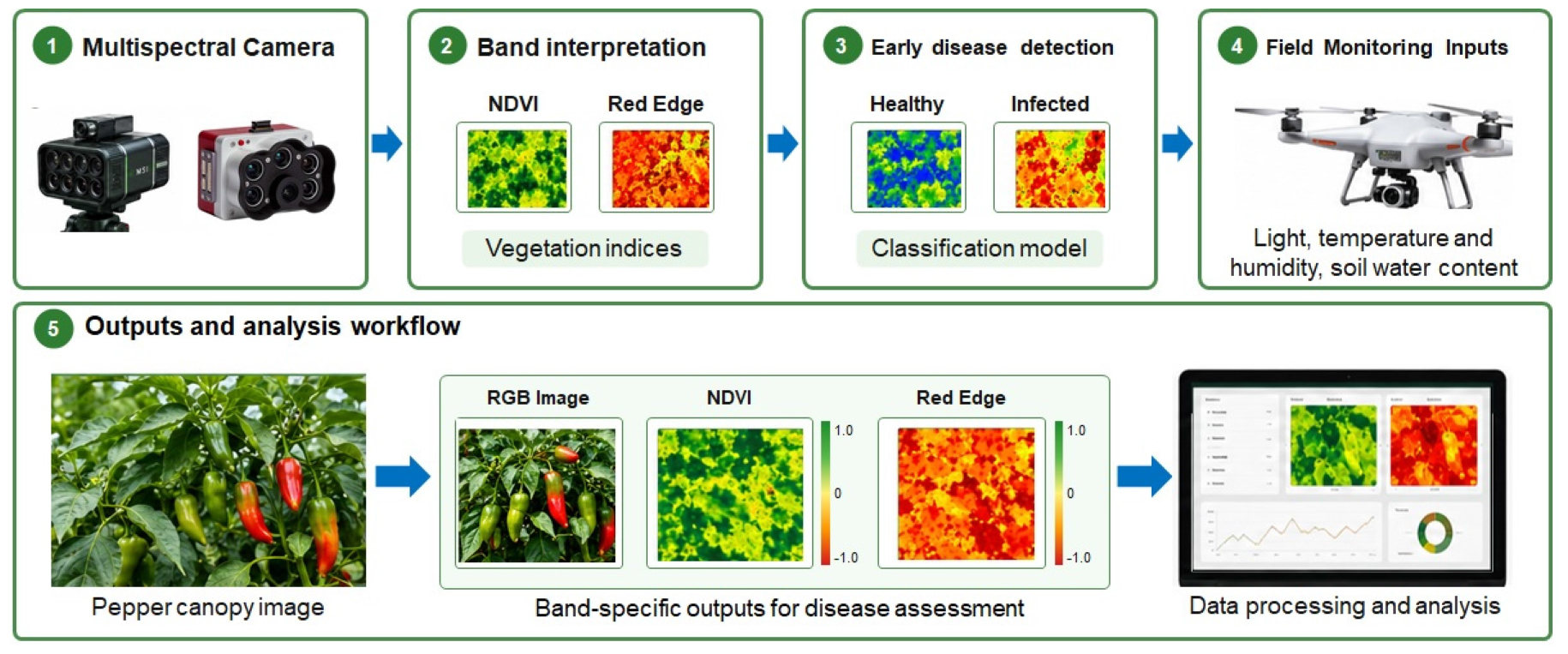
In potato, multispectral imaging can detect canopy stress associated with late blight, early blight, and other diseases before widespread canopy collapse occurs. Rodríguez et al. (2021b) used UAV-based multispectral imagery and machine-learning algorithms to assess potato late blight under field conditions. Such systems can identify affected zones and support spatially targeted field inspection or chemical application. Potato tubers develop below the soil surface; therefore, multispectral imaging primarily detects indirect above-ground responses, such as changes in canopy reflectance, chlorophyll content, and vegetation indices. Integrating multispectral imagery with environmental measurements, including soil moisture, temperature, rainfall, and leaf wetness, may improve the accuracy of disease-risk prediction. Fig. 3 illustrates the use of multispectral imaging for the early detection of diseases in pepper plants.
Hyperspectral imaging records reflectance across hundreds of narrow and contiguous wavelength bands. It provides detailed information about pigment concentration, tissue structure, moisture content, biochemical composition, and disease-related physiological responses. Compared with multispectral systems, hyperspectral sensors can identify subtle spectral differences and may distinguish diseases that produce similar visible symptoms (Mahlein, 2016; Xie et al., 2020; Choi et al., 2026).
For pepper plants, hyperspectral imaging has potential for detecting early biochemical and physiological changes associated with fungal, bacterial, oomycete, and viral infection. It may be particularly useful for distinguishing disease stress from water or nutrient stress before severe visible symptoms develop. Hyperspectral approaches for tomato early and late blight have achieved approximately 94–100% classification accuracy using extreme learning machine classifiers, whereas detection of asymptomatic gray mold at one day after inoculation remained substantially more difficult, with reported accuracies of approximately 44–66% (Xie et al., 2015). These results demonstrate that hyperspectral sensing can improve early diagnostic sensitivity, but its advantage depends strongly on disease-development stage and the magnitude of the physiological responses.
Hyperspectral imaging has been extensively investigated for detecting rusts, blights, mildews, and other foliar diseases in grain crops. Disease infection may alter visible, red-edge, and near-infrared reflectance through changes in pigments, cellular structure, and water status. Hyperspectral data can therefore support disease classification, severity estimation, and differentiation between visually similar stress conditions. At the field scale, however, hyperspectral monitoring is affected by illumination, atmospheric conditions, crop geometry, and mixed pixels containing soil, healthy tissue, and infected tissue. UAV-based hyperspectral systems offer broad spatial coverage but require careful calibration and substantial data-processing capacity. In potato, hyperspectral imaging can potentially identify physiological changes associated with late blight before large necrotic lesions develop. It may also help distinguish late blight from early blight or non-pathogenic stresses that produce similar canopy discoloration. Nevertheless, as with other optical methods, hyperspectral imaging primarily evaluates above-ground canopy responses and cannot directly observe diseased tubers in the soil. Despite its diagnostic potential, hyperspectral imaging remains less widely adopted than RGB and multispectral imaging because of its high cost, complex processing requirements, and limited suitability for rapid real-time field operation.
Thermal imaging measures the surface temperature of leaves and crop canopies. Pathogen infection can disrupt stomatal regulation, transpiration, and water transport, causing diseased tissue to become warmer or occasionally cooler than healthy tissue. Thermal cameras can therefore reveal physiological stress before strong visible symptoms appear (Prashar and Jones, 2014). Thermal imaging is particularly relevant for pepper diseases that affect roots, crowns, and vascular tissues. Phytophthora blight and Fusarium wilt can restrict water uptake and transport, resulting in reduced transpiration and increased leaf temperature. Thermal sensing may therefore detect stressed pepper plants even when the initial infection site is concealed beneath the soil or inside the canopy. Table 2 highlights the crop-specific strategy for pepper, combining RGB–thermal imaging, CNN/YOLO-based detection, and a canopy-aware smart nozzle sprayer. This integration enables physiological stress detection and spatial disease localization for targeted nozzle-level chemical application.
Pepper canopy temperature is influenced by irrigation, solar radiation, greenhouse ventilation, humidity, and fruit load. Thermal information should therefore be interpreted together with RGB or multispectral images and environmental measurements. In grain fields, thermal imaging can identify canopy-temperature differences associated with disease-induced reductions in transpiration. UAV-mounted thermal cameras can map spatial stress patterns across maize, wheat, soybean, and peanut fields. This approach may support rapid identification of areas requiring detailed inspection. Thermal anomalies are not disease-specific, however, because drought, nutrient deficiency, soil variability, and heat stress can produce similar temperature patterns. Sensor fusion and disease-risk models are consequently required to distinguish pathogen infection from abiotic stress.
In potato, thermal imaging can detect changes in canopy temperature associated with impaired water transport, wilting, and disease progression. It may be particularly useful when root, stem, or tuber infection influences plant water relations before extensive foliar necrosis occurs. Thermal measurements are strongly affected by solar radiation, ambient temperature, wind speed, humidity, and measurement time. Standardized acquisition conditions and integration with spectral or environmental data are therefore essential for reliable interpretation.
Machine learning and deep learning for disease diagnosis
Machine learning and deep learning algorithms are used to convert imaging and sensor data into disease classifications, lesion locations, severity estimates, and treatment recommendations. Conventional machine-learning methods, including support vector machines, random forests, k-nearest neighbors, and partial least-squares discriminant analysis, commonly use manually extracted spectral, textural, color, and morphological features. These methods can perform effectively with relatively limited datasets but depend heavily on appropriate feature selection (Atulinda et al., 2026).
Deep-learning models, particularly CNNs, automatically learn hierarchical image features and have achieved strong performance across multiple crop-disease datasets (Ferentinos, 2018; Too et al., 2019). Classification models determine disease category, object-detection models such as YOLO and Faster R-CNN localize symptoms, and segmentation models such as Mask R-CNN and U-Net delineate diseased tissue. Transfer learning using models pretrained on large image datasets is particularly useful when crop-specific labeled datasets are limited (Mohanty et al., 2016). For pepper plants, deep learning is used to classify leaf and fruit diseases, detect small lesions, and identify infected plants within complex backgrounds. Object-detection models are especially relevant because they can localize symptoms on individual leaves or fruits and potentially guide plant-level or nozzle-level spraying. However, pepper datasets must represent varying symptom sizes, cultivars, illumination conditions, canopy densities, and levels of occlusion.
High-capacity vision models such as Faster R-CNN and Mask R-CNN can provide high detection and instance-segmentation accuracy, particularly for small, irregular, or partially occluded disease symptoms. However, their computational complexity and inference latency can reduce processing throughput and limit real-time deployment on field sprayers operating under variable travel speeds and canopy conditions. In contrast, lightweight one-stage detectors and compact CNN architectures, such as YOLO-based models and MobileNet variants, generally provide higher inference speed and lower computational demand, facilitating rapid image processing, disease localization, and timely nozzle actuation. This efficiency may, however, be accompanied by reduced sensitivity to small lesions or subtle early-stage symptoms. Therefore, practical disease-targeted spraying requires optimization of the accuracy–latency trade-off rather than maximizing detection accuracy alone. Future development should emphasize model pruning, quantization, knowledge distillation, lightweight backbone design, and hardware-aware deployment on edge GPUs or embedded accelerators to minimize end-to-end inference and actuation latency while maintaining reliable disease detection under field-scale operating conditions.
For grain crops, machine learning can integrate RGB, multispectral, hyperspectral, and thermal data to classify disease, estimate severity, and produce field-scale disease maps. UAV data combined with classification or regression models are useful for detecting spatial disease patterns across large production fields. However, model performance may decline when transferred among geographic regions, cultivars, crop stages, or imaging platforms. For potato, deep learning can classify foliar diseases, segment late-blight lesions, estimate disease severity, and analyze UAV-derived disease patterns. Models can also combine canopy imagery with environmental variables to improve disease-risk prediction. Because underground tubers cannot be directly observed using conventional aerial imaging, machine-learning models should incorporate indirect canopy responses, soil information, and weather conditions.
The most effective disease-detection strategy differs among crop categories. Pepper and other upland vegetables benefit from close-range, multi-organ imaging and object detection; grain crops benefit from UAV-based field mapping and scalable canopy analysis; and potato and other root or tuber crops require integration of above-ground imaging with soil and environmental information. Multimodal sensor fusion and robust machine-learning models are therefore essential for developing reliable crop-specific disease-detection systems under practical field conditions. Table 2 shows crop-specific sensing and precision spraying approaches for major upland row crops.
Table 2
Crop-specific sensing, AI-based disease detection, and precision spraying approaches for major upland row crops.
| Crop | Target location | Preferred sensing | AI method | Suitable sprayer | References |
| Pepper |
Leaves and fruits |
RGB + thermal imaging | CNN / YOLO |
Canopy-aware smart nozzle sprayer | Bezabh et al. (2023b); Duan et al. (2024); Liu and Wang (2024); Zhang et al. (2025) |
| Wheat |
Leaves and canopy |
UAV multispectral imaging | CNN / deep learning |
Variable-rate boom sprayer | Dean et al. (2012); Mahlein (2016); Savary et al. (2019) |
| Maize |
Leaves and canopy | UAV RGB imaging | CNN |
Variable-rate boom sprayer | Mueller et al. (2016); Pan et al. (2022); Savary et al. (2019) |
| Potato |
Leaves and canopy |
UAV + thermal imaging | Image segmentation |
UAV or variable-rate field sprayer | Rodríguez et al. (2021b); Gao et al. (2021); Dutta et al. (2024) |
| Cotton | Canopy |
Multispectral imaging | Machine learning |
UAV or variable-rate boom sprayer | Ma et al. (2024); Li et al. (2024) |
Precision chemical application technologies
Precision chemical application represents a fundamental transition from uniform, calendar-based spraying toward site-specific and data-driven crop protection. Conventional spraying generally applies a constant pesticide rate across an entire field without accounting for differences in disease occurrence, canopy structure, crop growth stage, or infection severity. Precision application systems instead use disease maps, real-time sensors, machine vision, positioning systems, and automated nozzle control to determine where, when, and how much pesticide should be applied (Mulla, 2013; Tagarakis and Ketterings, 2018).
The principal objective is to maintain effective disease control while reducing pesticide consumption, production costs, spray drift, environmental contamination, and unnecessary exposure of operators and non-target organisms (Gebbers and Adamchuk, 2010; Popp et al., 2013). However, application requirements differ among crop groups. Pepper requires close-range and canopy-specific spraying because disease symptoms may occur on leaves, stems, crowns, and fruits. Grain crops are commonly cultivated over large continuous areas and are suitable for boom sprayers, UAV spraying, and map-based variable-rate application. Root and tuber crops such as potato require treatment of the above-ground canopy while considering soil moisture, disease-risk conditions, and the potential movement of pathogens from foliage to underground tubers.
Pepper plants have a relatively complex canopy composed of overlapping leaves, branches, flowers, and fruits. Diseases such as bacterial spot, anthracnose, powdery mildew, Phytophthora blight, and viral diseases may affect different plant organs and may occur in localized patches. Therefore, precision spraying in pepper production should provide accurate plant-level targeting and sufficient penetration into the inner and lower canopy.
Ground-based smart sprayers are particularly suitable for pepper because cameras and other proximal sensors can be positioned close to the crop. Machine-vision systems can detect visible disease symptoms or identify infected plants, after which individually controlled nozzles can apply pesticide only to the selected canopy region. Sensor-triggered spraying is especially beneficial when infected plants are sparsely distributed because unnecessary application to healthy plants can be avoided (Jeon et al., 2011; Sun et al., 2022). Effective pepper spraying requires consideration of nozzle orientation, spray angle, droplet size, travel speed, airflow, and canopy density. Conventional top-down spraying may provide inadequate coverage of lower leaves, stems, hidden fruits, and the abaxial leaf surface. Air-assisted, electrostatic, and multi-directional spraying systems can improve droplet movement and adhesion within dense vegetable canopies. LiDAR or machine-vision systems may also be used to estimate canopy dimensions and adjust nozzle position and spray volume according to plant height and density (Andújar et al., 2013; Toscano et al., 2024).
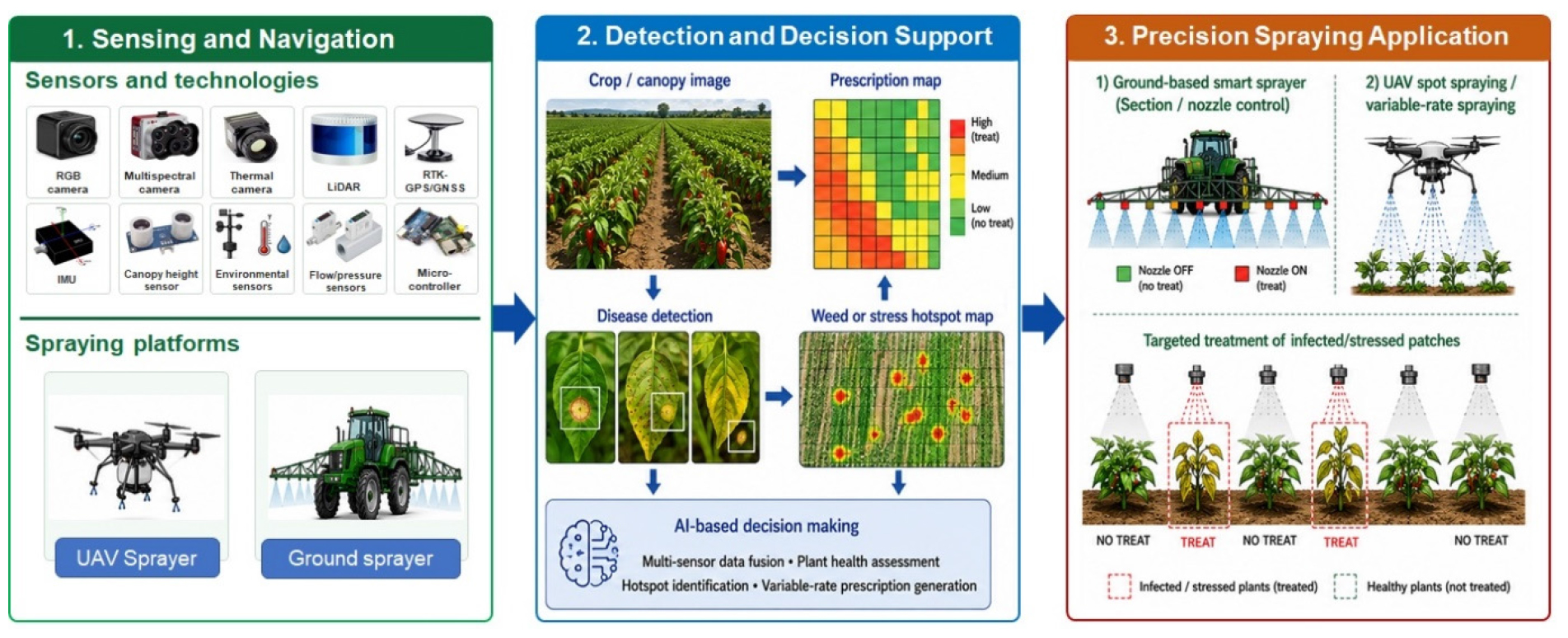
Ground robots have strong potential for precision spraying in pepper fields and protected cultivation systems. Because these platforms operate at relatively low speeds and close to the plants, they can perform repeated disease monitoring and localized low-volume spraying. A robotic platform may integrate row navigation, RGB or multispectral imaging, disease classification, target localization, and individual-nozzle control within a single system (Sun et al., 2022). UAV-based spraying may be useful in large open-field pepper production, particularly when disease maps have already been generated. However, top-down aerial application may have difficulty reaching stems, crowns, lower leaves, and fruits concealed by the upper canopy. UAVs may therefore be more effective for disease monitoring and prescription-map generation, while ground-based sprayers perform plant-level treatment. Fig. 4 presents an integrated framework linking field sensing, AI-based decision support, and precision spraying for disease management in upland row crops.
Grain crops considered in this review include maize, wheat, soybean, and peanut. These crops are generally cultivated over large and relatively continuous fields, making them suitable for wide-boom sprayers, section-controlled spraying systems, prescription-map-based variable-rate application, and UAV spraying. Variable-rate boom sprayers can adjust spray rate, nozzle activation, and application pressure according to georeferenced disease maps. Individual-nozzle or section control can prevent pesticide application in healthy zones and increase the rate in locations with higher disease severity. Map-based spraying is particularly appropriate when UAV, satellite, or field-scouting data have identified spatial disease patterns before treatment (Mulla, 2013; Tagarakis and Ketterings, 2018).
Sensor-based spraying provides an alternative when disease conditions must be evaluated during machine operation. Cameras, multispectral sensors, or canopy sensors mounted on a tractor or sprayer can identify diseased plants, canopy gaps, or abnormal vegetation conditions in real time. The control system then activates selected nozzles or modifies the application rate according to the detected target. The effectiveness of this approach depends on disease-detection accuracy, processing speed, nozzle response time, machine travel speed, and the spatial size of disease patches (Jeon et al., 2011; Sun et al., 2022).
UAV-based spraying is especially relevant to large-scale grain production because extensive areas can be treated rapidly, including fields where wet soil, steep terrain, or poor accessibility restrict the use of heavy ground machinery. Multirotor UAVs generate rotor downwash that alter droplet movement, canopy penetration, deposition uniformity, and spray drift. Application performance is therefore strongly affected by flight height, flight speed, rotor operating conditions, nozzle type and position, spray pressure, droplet size, spray volume, wind speed, temperature, and relative humidity (Sahni et al., 2024; Alidoost Dafsari et al., 2024; Boskovic et al., 2026). Recent experimental evidence further indicates that interactions among flight altitude, droplet spectrum, herbicide formulation, and meteorological conditions can substantially influence UAV application efficacy in wheat fields (Boskovic et al., 2026).
Differences in grain-crop canopy structure must also be considered when selecting operating parameters. Wheat and soybean generally develop relatively continuous canopies, whereas mature maize forms a taller and more vertically layered canopy. Consequently, a spraying configuration developed for wheat may not provide equivalent deposition and penetration in maize. Nozzle angle, atomization level, spray volume, airflow assistance, and flight or boom height should therefore be adjusted according to crop height, canopy density, row spacing, leaf orientation, and the location of the disease within the canopy. Field experiments in maize and rice have demonstrated that optimum droplet atomization and deposition patterns differ by crop, confirming that UAV spraying parameters should be selected according to canopy characteristics rather than applied uniformly across crop species (Yao et al., 2025).
Large-scale grain production is well suited to integrated UAV–ground sprayer systems. UAV imagery can initially be used to identify disease or weed hotspots, estimate their severity, and generate georeferenced prescription maps. These maps can subsequently be transferred to either commercial ground sprayers or UAV sprayers for site-specific or variable-rate application. In maize, UAV-derived weed maps have been successfully transferred to a commercial ground sprayer, allowing untreated zones to be excluded and reducing the area receiving herbicide by approximately 26% (Sapkota et al., 2023). Similarly, UAV multispectral imagery has been used to estimate spatial disease severity and generate pesticide prescription maps, while LiDAR- and RGB-based crop measurements have supported biomass-responsive variable-rate UAV spraying in wheat (Li et al., 2024; Liu et al., 2025). Such integration reduces dependence on continuous blanket spraying and enables chemical application rates to be adjusted according to measured disease severity, crop biomass, or weed distribution. In root and tuber crops such as potato, pesticide application primarily targets the above-ground canopy, although the economically valuable product develops below the soil surface. Foliar diseases such as late blight and early blight can spread rapidly across leaves and stems and may subsequently affect tuber health and storage quality. Therefore, timely canopy treatment is necessary to prevent disease progression and reduce the transfer of inoculum from infected foliage to tubers (Savary et al., 2019).
Ground-based boom sprayers are widely applicable to potato because the crop is cultivated in regular rows and generally forms a relatively continuous canopy. Variable-rate systems can adjust pesticide application according to disease-risk maps, observed infection severity, or canopy characteristics. Individual nozzle control may be used to target infected field zones while limiting unnecessary application in unaffected areas (Gebbers and Adamchuk, 2010).
Map-based application is particularly useful for potato because disease development is strongly associated with environmental and field conditions, including temperature, rainfall, relative humidity, leaf-wetness duration, soil moisture, and drainage. Disease-risk models combining weather data, field observations, and remote-sensing information can be used to identify zones where preventive or curative treatment is most urgently required (Mahlein, 2016).
Sensor-based spraying can use RGB, multispectral, or thermal sensors to identify abnormal canopy conditions during operation. However, the sprayer must distinguish disease stress from other causes of canopy variability, such as water stress, nutrient deficiency, mechanical damage, and natural senescence. Integration of canopy imaging with environmental and soil measurements can therefore improve spray decisions (Xie et al., 2022). UAVs can support both disease mapping and chemical application in potato fields. Aerial imagery can reveal spatial differences in canopy vigour and disease severity, while UAV sprayers can treat selected zones where ground access is difficult (Ronzhin et al., 2026). Nevertheless, UAV spraying primarily reaches above-ground foliage and cannot directly treat infected tubers or deeply distributed soil-borne pathogens. Management of root-zone and tuber diseases may therefore require integration with seed treatment, soil treatment, irrigation management, drainage improvement, or other non-foliar control practices.
Canopy penetration is another important consideration in potato spraying. As plants mature, overlapping leaves can restrict droplet movement into lower canopy layers, where high humidity may favour pathogen development. Appropriate nozzle selection, spray volume, droplet size, and application angle are therefore necessary to achieve uniform leaf coverage while minimizing runoff and drift (Xie et al., 2022). Ground-based precision spraying systems include variable-rate boom sprayers, machine-vision-guided smart sprayers, electrostatic sprayers, LiDAR-guided sprayers, and autonomous robotic platforms. These systems combine sensing, decision-making, and actuation to adjust chemical delivery according to crop condition and disease distribution (Jiao et al., 2025). Variable-rate boom sprayers are most applicable to large grain and potato fields because they can cover wide working widths while adjusting individual nozzle or boom-section output (Singh Dalal, 2026). In pepper production, narrower boom systems, side-facing nozzles, or robotic sprayers may be more appropriate because treatment must be directed toward individual plants and multiple canopy layers.
Machine-vision-guided systems use onboard cameras and AI models to identify diseased plants or canopy regions in real time. Once a target is detected, the controller activates the corresponding nozzle after accounting for machine speed and the distance between the camera and spray outlet. Precise synchronization is important because any delay between detection and nozzle activation can cause the spray to miss the intended target (Andújar et al., 2013). Electrostatic spraying charges droplets to improve their attraction to plant surfaces. This method can increase deposition on complex leaf surfaces and may improve coverage of the underside of leaves. LiDAR-guided systems measure canopy height, width, density, and spatial structure, allowing spray volume and nozzle direction to be adapted to the target canopy (Andújar et al., 2013).
Autonomous ground sprayers integrate navigation, sensing, disease detection, spray control, and safety systems. They are particularly promising for pepper and other high-value vegetable crops because they can operate close to individual plants. However, practical implementation remains constrained by navigation reliability, field obstacles, sensor accuracy, nozzle response, cost, maintenance requirements, and operational safety (Pierpaoli et al., 2013). UAV sprayers provide rapid field coverage and can operate in areas where ground machinery may cause soil compaction, crop damage, or accessibility problems (Sassu et al., 2024). They can also apply chemicals using prescription maps generated from RGB, multispectral, hyperspectral, or thermal imagery (Li et al., 2024). In grain and potato fields, UAV sprayers can treat disease hotspots identified from aerial surveys. Their effectiveness depends on payload capacity, battery duration, flight height, travel speed, droplet characteristics, wind conditions, and spatial positioning accuracy. Rotor-generated downwash may improve droplet movement into the canopy, although excessive airflow may also increase droplet displacement or drift (Sahni et al., 2024).
For pepper, UAV spraying is more suitable for broad canopy treatment than for highly localized stem, fruit, or crown application. Dense foliage can intercept droplets before they reach lower plant organs. UAV systems equipped with adjustable or multi-directional nozzles may improve coverage, but close-range ground spraying generally offers greater precision for concealed plant parts (Godyń et al., 2025). UAVs have particularly strong value as sensing and mapping platforms. Disease maps generated from aerial imagery can guide ground robots, boom sprayers, or subsequent UAV spraying missions. This division of functions allows wide-area monitoring to be combined with more precise ground-level treatment.
Variable rate technology
Variable-rate technology adjusts chemical application according to spatial or temporal differences in disease risk. Two principal approaches are map-based and sensor-based application. Precision pesticide application can reduce chemical use by approximately 12–30%, depending on the crop, sensing method, and application technology is the practical. This range indicates that matching pesticide rates to spatially variable disease pressure can substantially reduce unnecessary chemical inputs compared with uniform application. Map-based variable-rate spraying uses prescription maps generated before spraying. Input data may include UAV imagery, crop scouting, disease severity maps, soil properties, weather records, and disease-risk models. The sprayer uses GNSS positioning to identify its location and apply the assigned pesticide rate within each management zone (Mulla, 2013). This approach is well suited to large grain and potato fields where disease patches can be mapped across broad areas. In pepper fields, map-based spraying may identify infected rows or field sections, although plant-level treatment may require higher spatial resolution than conventional field maps provide.
Sensor-based variable-rate spraying detects crop or disease conditions during operation. Machine vision, spectral sensors, LiDAR, or thermal cameras provide real-time information, and the controller immediately modifies nozzle activation or application rate. This approach is especially useful for pepper and other vegetable crops where infected plants may occur individually or in small clusters. Its success depends on rapid data processing, accurate target recognition, precise localization, and fast nozzle response (Tagarakis and Ketterings, 2018; Sun et al., 2022). As summarized in Table 3, this targeted application strategy has broader environmental implications, with precision pesticide technologies reported to reduce pesticide application by 12.8% and greenhouse-gas emissions by 9.4% (Lan and Ban, 2025). These reductions demonstrate that variable-rate control can improve input-use efficiency while simultaneously lowering the environmental burden associated with pesticide application.
The complete precision crop-protection process includes sensing, disease diagnosis, treatment decision-making, chemical application, and post-treatment evaluation. Images and sensor data are first collected using UAVs, ground vehicles, robots, or fixed sensing systems. AI algorithms then classify disease presence, severity, and spatial location (Kang et al., 2026). These outputs are converted into treatment decisions or prescription maps that specify the target area, chemical rate, and application timing. This site-specific decision process is consistent with the crop-protection benefit, where precision application is reported to enable timely disease control while improving spray coverage of the target canopy. This indicates that the value of variable-rate technology extends beyond pesticide reduction to improving the spatial and temporal accuracy of treatment. For pepper, integrated systems should support individual-plant or canopy-zone detection followed by close-range nozzle activation. For grain crops, disease maps can guide wide-boom or UAV-based variable-rate spraying over large field zones. For potato, canopy imagery should be combined with environmental and soil information to determine the risk of disease development and the appropriate timing of treatment.
Real-time closed-loop systems perform detection and spraying on the same platform. Such systems require reliable communication among sensors, processors, positioning units, controllers, and actuators. Detection accuracy alone is insufficient; the system must also respond quickly enough to activate the correct nozzle at the correct location while the platform is moving (Li et al., 2024; Sun et al., 2022). The benefits also indicate strong economic potential, with precision pesticide application increasing return on investment by 22.3% and net profit by 18.5% (Lan and Ban, 2025). Combined with a 12–30% reduction in chemical use, these results suggest improved profitability through lower input costs and more efficient crop protection. Future integrated systems are expected to combine UAV-based field monitoring, AI-driven disease mapping, autonomous ground navigation, and variable-rate spraying. Crop-specific design remains essential: pepper requires high-resolution plant-level targeting, grain crops require efficient large-area coverage, and potato requires integration of canopy detection with environmental and below-ground disease-risk information. Table 3 shows the benefits of integrated precision spraying systems.
Table 3
Agronomic, environmental, safety, and economic benefits of precision pesticide application technologies.
| Aspect | Reported impact | References |
| Pesticide-use efficiency | Reduces chemical use by approximately 12–30%, depending on the crop, sensing method, and application technology | Anastasiou et al. (2023) |
| Environmental sustainability | Improves input-use efficiency, reduces pesticide application by 12.8%, and lowers greenhouse-gas emissions by 9.4% | Lan and Ban (2025) |
| Operator safety | Minimizes direct pesticide handling and reduces occupational exposure through automated application | Anastasiou et al. (2023) |
| Crop protection performance | Enables timely, site-specific disease control and improves spray coverage of the target canopy | Anastasiou et al. (2023) |
| Economic performance | Increases return on investment by 22.3% and net profit by 18.5% | Lan and Ban (2025) |
Challenges and future research
Despite significant progress in disease detection and precision chemical application technologies, several scientific and engineering challenges continue to limit their widespread adoption in upland row-crop production. One of the primary challenges is the large variation in crop architecture, disease symptoms, and infection locations among different crop groups. Vegetable crops such as pepper require high-resolution monitoring of leaves, stems, fruits, and crown tissues within dense canopies (Bezabh et al., 2023a; Duan et al., 2024), whereas grain crops demand efficient large-area monitoring over extensive fields (Pan et al., 2022; Savary et al., 2019). Root and tuber crops, including potato, present additional complexity because economically important organs develop below ground, requiring indirect assessment of disease through canopy responses and environmental indicators (Rodríguez et al., 2021b; Gao et al., 2021). Consequently, disease-detection and spraying systems cannot rely on a single sensing or application strategy but must be adapted to crop-specific biological and structural characteristics (Mahlein, 2016; Kamilaris and Prenafeta-Boldú, 2018).
Another major challenge is achieving robust disease detection under practical field conditions. RGB imaging performs well after visible symptoms appear but is sensitive to illumination changes, shadows, canopy occlusion, soil background, and symptom similarity. Although multispectral, hyperspectral, and thermal imaging enable earlier detection of physiological stress, their performance is influenced by environmental variability, sensor calibration, crop growth stage, and non-disease stresses such as drought or nutrient deficiency. Developing robust multimodal sensing systems capable of distinguishing biotic from abiotic stress remains an important research priority (Mahlein, 2016; Prashar and Jones, 2014; Xie et al., 2020). Furthermore, most deep-learning models are trained using limited datasets collected under specific environmental conditions, resulting in reduced generalization when applied across different cultivars, geographic regions, imaging platforms, and growing seasons (Kamilaris and Prenafeta-Boldú, 2018; Barbedo, 2019).
Adoption of precision crop-protection technologies is constrained by both technical and social barriers. Technically, advanced sensors, UAV platforms, AI-enabled controllers, and variable-rate sprayers require reliable calibration, communication, power supply, and interoperability under field conditions characterized by dust, humidity, temperature variation, vibration, and changing illumination. Sensor drift, communication delays, model uncertainty, maintenance requirements, and limited compatibility among hardware and software platforms can reduce long-term system reliability. Socially, high capital costs, uncertain return on investment, limited access to technical support, and insufficient farmer training remain major obstacles, particularly for small- and medium-scale farms. Trust in automated decision-making and willingness to adopt AI- or UAV-based systems also depend on system transparency, ease of use, and demonstrated field performance. Regulatory restrictions on UAV pesticide application and data-management requirements may further limit deployment. Therefore, wider adoption will require not only robust and interoperable technologies, but also affordable system designs, user-friendly interfaces, extension support, farmer training, and clear regulatory frameworks.
The implementation of precision chemical application also faces several technical challenges. Effective spraying depends not only on accurate disease detection but also on appropriate nozzle selection, droplet size, spray angle, travel speed, canopy penetration, and synchronization between sensing and actuation. These requirements differ substantially among crop types. Dense pepper canopies require plant-level targeting and improved penetration into lower leaves and fruits, whereas grain crops benefit from wide-area variable-rate boom or UAV spraying. Potato production requires treatment strategies that consider canopy development together with environmental conditions influencing disease spread. Achieving accurate real-time coordination between disease detection, positioning, and spray control remains difficult under dynamic field operating conditions (Tagarakis and Ketterings, 2018; Sun et al., 2022; Sahni et al., 2024). Fig. 5 summarizes the major crop-specific challenges, disease-detection limitations, precision spraying constraints, future research priorities, and expected outcomes for precision crop-protection systems in upland row crops.
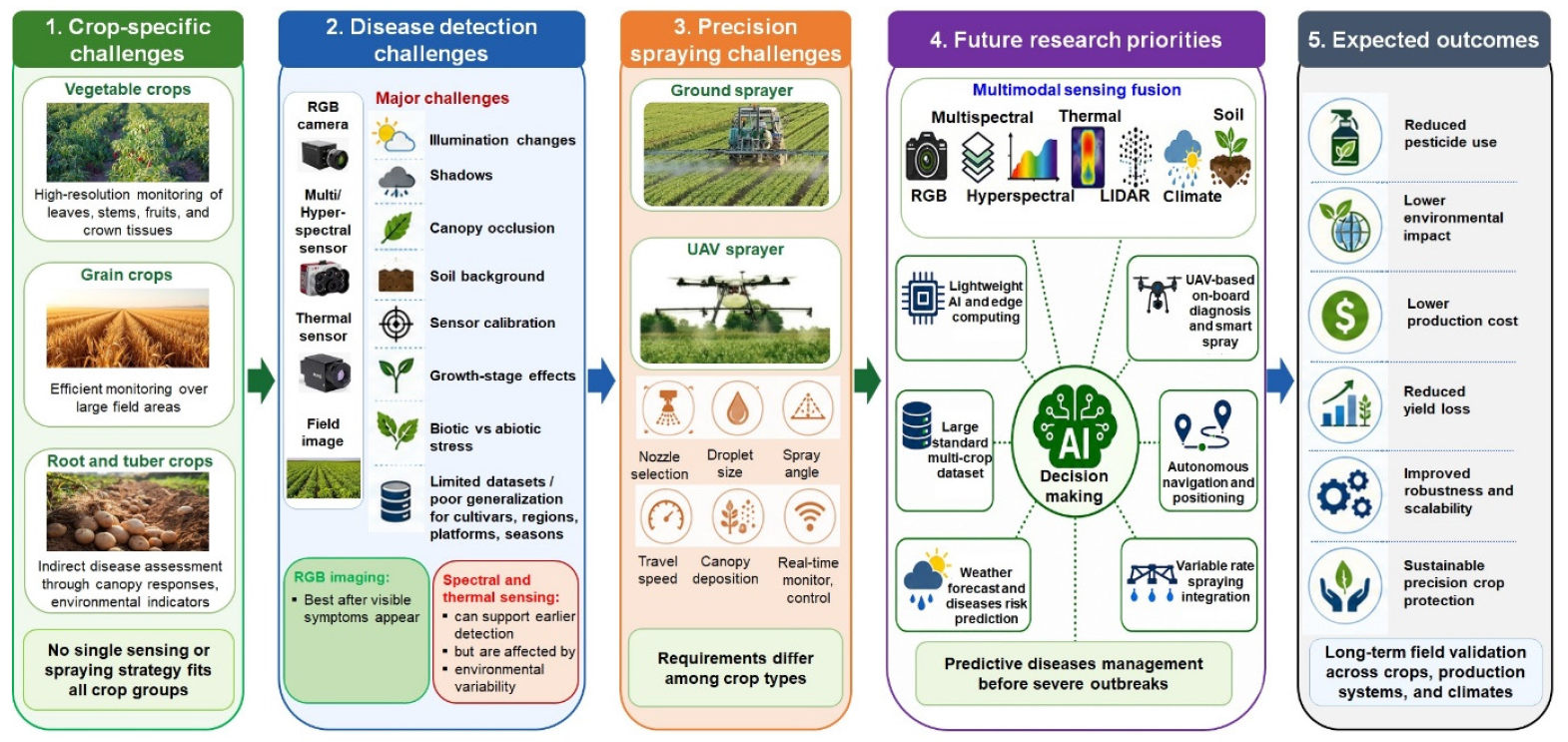
Future research should therefore emphasize integrated, crop-specific precision crop-protection systems rather than isolated sensing or spraying technologies. Multimodal sensor fusion combining RGB, multispectral, hyperspectral, thermal, LiDAR, environmental, and soil sensors offers considerable potential to improve disease detection across different crops and disease-development stages. Advances in lightweight AI models, edge computing, and onboard processing will enable real-time disease diagnosis and autonomous decision-making directly on UAVs, robotic platforms, and smart sprayers. Equally important is the development of large, standardized, multi-crop datasets collected under diverse field environments to improve model robustness and facilitate meaningful comparisons among detection algorithms (Mohanty et al., 2016; Too et al., 2019).
Precision crop-protection systems should also integrate disease detection with variable-rate spraying, autonomous navigation, weather forecasting, and disease-risk prediction models. Instead of responding only to visible symptoms, next-generation systems should combine physiological sensing, environmental monitoring, historical disease occurrence, and weather information to support predictive disease management before severe outbreaks occur. Long-term field validation across different crops, production systems, and climatic regions will be essential to quantify reductions in pesticide use, environmental impact, production cost, and yield loss. Such evidence will support the development of reliable, economically feasible, and sustainable precision crop-protection technologies for diverse upland row-crop production systems.
Conclusions
The integration of advanced disease detection with precision chemical application provides a practical pathway toward more efficient and sustainable crop protection in upland row crops. RGB, multispectral, hyperspectral, and thermal sensing, combined with machine- and deep-learning methods, can support disease classification, localization, severity assessment, and spatial mapping. However, sensing and spraying strategies must be adapted to crop-specific characteristics, including dense vegetable canopies, large grain fields, and the indirect disease indicators required for root and tuber crops.
Variable-rate boom sprayers, smart nozzles, UAVs, and autonomous ground robots can reduce unnecessary pesticide use by targeting infected plants and high-risk zones. Their performance depends on accurate detection, rapid decision-making, precise positioning, canopy penetration, and reliable coordination between sensing and actuation.
Future progress should focus on integrated crop-specific systems that combine multimodal sensing, artificial intelligence, disease-risk prediction, autonomous navigation, and variable-rate spraying. Improved model generalization, affordable sensors, edge computing, standardized datasets, and long-term field validation will be essential to confirm reductions in pesticide use, production cost, environmental impact, and disease-related yield loss.